

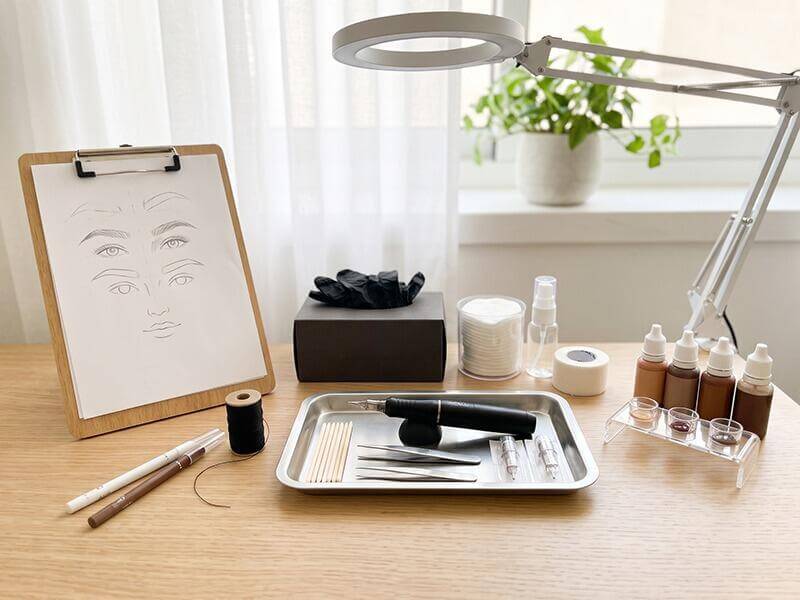
The prohibited tattoo was formerly made by cutting the skin and inserting pigment through the incision * Today, this is done by puncturing the skin with tiny holes through which pigment is inserted deep into the skin * Permanent makeup is performed using the same method as ordinary tattooing, but a tattoo remains for life, whereas permanent makeup fades within a few years * Some authorities are lenient and maintain that the prohibition applies only to permanent tattooing * According to the stringent authorities, temporary makeup has the same status as a permanent tattoo * Those who wish to be lenient and have permanent makeup applied for cosmetic purposes may rely on the authorities who maintain that there is no prohibition, but ideally it is proper to be stringent
Q: Is it permissible to have permanent makeup applied that resembles tattooing? For some people, the need for this is very great, such as women whose eyebrows have fallen out following cancer treatments, or someone who has been injured and has severe facial scars, which can be made less noticeable by tattooing with skin-colored pigment. There are also elderly women who suffer from Parkinson’s disease and whose hands tremble, making it very difficult for them to apply makeup every day as they used to. Other women are allergic to makeup products and, while they were younger, refrained from wearing makeup, but as the years have passed, they have developed a strong desire to do so.
There are also people who wish to have permanent makeup not because of any great need, but simply because they want it, such as women who wish to save the time spent applying makeup every day. There are also women and men who are eager to get a tattoo, but because they know that this is prohibited by the Torah, they seek to have a temporary tattoo instead. Is this permissible?
A: Before explaining the answer, we must define what a tattoo is, and what temporary makeup is.
What Constitutes a Prohibited Tattoo?
In general, the skin has two layers. The outer layer (epidermis) is composed of cells that are replaced and shed within a few weeks. Therefore, as long as the pigment penetrates only the outer layer, it will gradually fade, at most within a few weeks.
By contrast, in the inner layer (dermis), the pigment remains trapped inside cells that are not shed. Therefore, although these cells are also replaced over time, since they are not shed, the pigment remains in the same tissue. Consequently, it remains there for years, and only after many years does it fade somewhat.
In the past, the prohibited tattoo was made by cutting the skin and inserting pigment through the incision. Thus, when the skin healed and closed, the pigment remained trapped deep within the skin permanently. Today, this is done by puncturing the skin with tiny holes through which the pigment is inserted deep into the skin.
What Is Permanent Makeup or a Temporary Tattoo?
Permanent makeup is performed using the same method as ordinary tattooing. However, in ordinary tattooing, a large quantity of strong pigment is inserted deep into the inner layer of the skin (dermis), whereas in permanent makeup, a smaller quantity of weaker pigment is inserted more superficially.
This difference stems from the fact that the purpose of permanent makeup is to complement facial features that change over the years. Therefore, it is designed from the outset to fade after several years, allowing it to be reapplied and adjusted as needed. If it were to remain permanently, it would gradually become unsuitable as a result of changes in age and in the skin.
In summary: A tattoo remains for one’s entire life, whereas permanent makeup fades after a few years.
The Lenient Opinion – The Prohibition Applies to Permanent Tattooing
There are authorities who take a lenient view and maintain that the prohibition applies only to tattooing that is permanent, as Rashi explained (Leviticus 19:28; Gittin 20b), that a tattoo inscription “does not fade away forever,” whereas permanent makeup is not everlasting. Other Rishonim likewise wrote that a tattoo inscription remains forever. Among them are the Rivan, Rabbeinu Hillel, the Bekhor Shor, Rabbi Yehuda ben Rabbi Yitzhak (Ri Paltiel), the RiD, the Or Zarua, Sefer HaChinuch, and the Ritva, among others. Several later authorities defined it similarly: Korban Aharon, Kitzur Shulchan Aruch 169:1, and Aruch HaShulchan, Even HaEzer 124:20.
Additional Arguments for Leniency
Even if we say that permanent makeup is considered equivalent to permanent tattooing, some authorities maintain that since it does not contain letters, its prohibition is only rabbinic. In that case, it may be permitted when there is a significant need to prevent embarrassment, since the general principle is that “great is human dignity,” which overrides rabbinic prohibitions (Berakhot 19b).
We will explain their arguments:
First, according to Rabbi Shimon (Makkot 21a), only a tattoo bearing the name of an idolatrous deity is prohibited by Torah law, while making other tattoos is prohibited by rabbinic law (Tosafot, Gittin 20b, s.v. Ketovet; Tosafot HaRosh there; Rabbi Yonatan of Lunel there, 21a).
Although the overwhelming majority of halachic authorities maintain that the law follows the opinion of the Tanna Kamma (first anonymous opinion), according to whom every design is prohibited by Torah law (Rambam, Laws of Idolatry 12:11; Sefer Yere’im; Orchot Chaim; Meiri; Ritva; Rabbeinu Yerucham, and many others), some authorities maintain that the law follows Rabbi Shimon (Rabbi Yonatan of Lunel; Kitzur Piskei HaRosh, Makkot 3:6; Rabbeinu Bachya on the Torah). In pressing circumstances, one may rely on their opinion.
There are also authorities who maintain that even according to the Tanna Kamma, only letters are prohibited by Torah law, whereas other designs are prohibited by rabbinic law. This is what was written in Responsa Me’il Tzedakah, no. 31, and this is also what he inferred from the Rambam and other Rishonim. This was likewise written in Responsa Yaskil Avdi (vol. 6, Yoreh De’ah 1:13).
However, according to most halachic authorities, every design is prohibited by Torah law (Raavad; Rash of Shantz; Tiferet Yisrael; Aruch LaNer; Chaim LeOlam, Yoreh De’ah 20; Minchat Chinuch 253:3). Even a design without any particular meaning is prohibited (Aruch LaNer; Yad HaKetana).
In summary: According to a minority of halachic authorities, a tattoo that does not consist of letters is prohibited only by rabbinic law. According to their approach, it is possible to permit such tattooing in order to prevent significant embarrassment, such as concealing a scar, or drawing eyebrows that have fallen out.
Rulings of the Lenient Authorities
Some authorities permit permanent makeup in pressing circumstances. This is what Rabbi Eliyahu Aberg’el wrote (Divrei Eliyahu 6:27), that women who are lenient have grounds upon which to rely, based on a safek sfeika (a double halachic doubt).
Similarly, Minchat Asher (2:56) wrote that in a situation of great need, one may be lenient, such as in the case of a woman with a facial scar. This was also written in Responsa Shraga HaMeir (8:44–45).
In Taharat HaBayit (3:8, pp. 28–33), based on the combination of all the various considerations, the Rishon LeTzion, Rabbi Ovadia Yosef, ruled leniently regarding permanent makeup even for cosmetic purposes. This was also written in Migdal Tzofim (3:33), as well as by Rabbi Ezra Batzri (Techumin 10, p. 282) and Rabbi Zalman Nechemia Goldberg (Responsa Binyan Ariel, Yoreh De’ah, p. 116).
Another argument for leniency is that even those who maintain that every design is prohibited may mean every design that is foreign to the body. However, permanent makeup, which complements the body’s natural features and does not create a design foreign to the body, is permitted. If this argument is accepted, it may be possible to permit permanent makeup for any purpose.
The Stringent Opinion
By contrast, according to the stringent authorities, temporary makeup has the same status as a permanent tattoo, since it is performed in the same manner, by inserting pigment deep into the skin. Although it lasts only a few years, a tattoo that lasts several years is also considered a tattoo.
This is implied by the wording of the Nimukei Yosef (Makkot 21a), who wrote that the prohibited tattoo is one that “remains visible for a long time.” Rabbi Yonatan of Lunel wrote similarly (Makkot, ibid.).
According to their understanding, even when the Rishonim wrote that a tattoo remains “forever,” they meant that it lasts for several years and is not like ordinary writing, which fades after a few weeks.
Furthermore, in their opinion, one should not take into consideration the view of the minority of halachic authorities who maintain that the Torah prohibition applies only to tattoos consisting of letters. Rather, the ruling should follow the majority of authorities, who maintain that every tattoo is prohibited by Torah law.
This is the practical ruling in Responsa Shevet HaLevi (10:137) and Lehorot Natan (10:64). This was also ruled in additional works by contemporary rabbis (see Responsa Avnei Derech 2:7). This was also the inclination of Hora’ah Berurah (Biur Halakha Ha’aruch 180:1:7).
Practical Halakha
In practice, those who wish to be lenient and have permanent makeup applied for cosmetic purposes may rely on the authorities who maintain that there is no prohibition. However, since there are stringent authorities, some of whom maintain that it is prohibited by Torah law, ideally it is proper to be stringent.
Nevertheless, when permanent makeup is needed to prevent embarrassment, such as drawing eyebrows that have fallen out, or concealing scars, one may initially rely on the lenient authorities who maintain that permanent makeup is permitted. This is because even according to many of the stringent authorities, permanent makeup is prohibited only by rabbinic law, and our Sages permitted violating their prohibitions in order to prevent significant embarrassment.
A Room Without a Door
Q: Is a room that has an entrance but no door to close it obligated in having a mezuzah?
A: According to the Rambam (Tefillin and Mezuzah 6:1), an entrance that has no door is exempt from having a mezuzah. This is also the opinion of Sefer HaChinuch (Mitzvah 423) and Kol Bo (at the end of the laws of mezuzah).
However, according to most of the Rishonim, even an entrance without a door is obligated in having a mezuzah (Raavad there; Ri’az, Mezuzah 43; Rosh, Mezuzah 8; Rabbeinu Yerucham 21:7. This also emerges from Rashi, Rabbi Yonatan of Lunel, Ri’d, Nimukei Yosef, Menachot 33a).
In practice, a mezuzah should be affixed there without reciting a blessing (Shach 286:25).
A Ceiling
Q: Is a room without a ceiling obligated in having a mezuzah?
A: A room that was intended to serve as a dwelling but has no ceiling is exempt from having a mezuzah, because it is not suitable for habitation. If part of it is covered, and that covered section is adjacent to the entrance and measures four by four cubits, it is obligated in having a mezuzah (Rabbeinu Yerucham; Shulchan Aruch, Yoreh De’ah 286:14).
However, if the room serves its intended purpose without a ceiling, such as a backyard or patio (an inner courtyard), it is obligated in having a mezuzah. This is because there is also an obligation to affix a mezuzah to a courtyard that is surrounded by a wall and has an entrance (Pitchei Teshuvah 286:13; Yad Shaul 9).
If Someone Removes His Tefillin, Must He Recite a Blessing When Putting Them on Again?
Q: If someone removes his tefillin with the intention of putting them on again, must he recite a blessing when he puts them on again?
A: He should not recite another blessing, since he did not divert his attention from them. However, if he intended to remove them for more than half an hour, when he puts them on again, he must recite another blessing.
Similarly, if he removed them in order to relieve himself in the bathroom or to pass gas, even if he removed them for only a few minutes, since he was required to remove them, when he puts them on again, he must recite another blessing (see Peninei Halakhah: Cheftzei Kodesh 3:11, note 12).
This article appears in the ‘Besheva’ newspaper and was translated from Hebrew.