

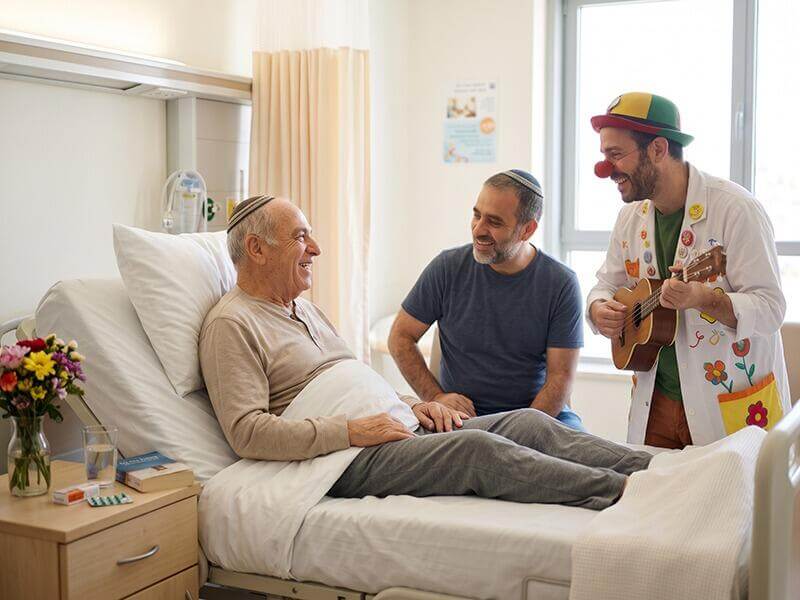
There are three purposes to the mitzvah of visiting the sick: helping the patient with whatever he needs, lifting his spirits, and being moved to pray for him * The mitzvah of those in the first and innermost circle is to attend to all of the patient’s ongoing needs * Those in the second circle are friends and more distant relatives, whose primary mitzvah is to encourage the patient * Visitors must be very careful not to burden the patient * The mitzvah of visiting the sick requires wisdom and sensitivity * It is not easy to know what will encourage a patient, and what will discourage him
It is a great mitzvah to visit the sick. It is an extension of the mitzvah of “Love your fellow as yourself” (Leviticus 19:18), about which Rabbi Akiva said that it is “a great principle of the Torah” (Sifra, ad loc.; Jerusalem Talmud, Nedarim 9:4). It is also stated: “And you shall teach them the statutes and the laws, and make known to them the way in which they must walk and the deeds they must do” (Exodus 18:20). Our Sages expounded: “‘The way’ refers to acts of loving-kindness; ‘they must walk’ refers to visiting the sick” (Bava Metzia 30b).
In addition, one who visits the sick cleaves to God and follows His ways. God created the world without completing it, so that human beings could follow His ways and add goodness to the world. As it is stated: “You shall follow the Lord your God, fear Him, keep His commandments, obey His voice, serve Him, and cleave to Him” (Deuteronomy 13:5). Our Sages asked: “Is it possible for a person to walk after the Divine Presence? Has it not already been stated: ‘For the Lord your God is a consuming fire’ (Deuteronomy 4:24)? Rather, it means to follow the attributes of the Holy One, blessed be He. Just as He clothes the naked… so too, you should clothe the naked. The Holy One, blessed be He, visited the sick, as it is stated: ‘The Lord appeared to him by the terebinths of Mamre’ (Genesis 18:1); so too, you should visit the sick. The Holy One, blessed be He, comforted mourners… so too, you should comfort mourners. The Holy One, blessed be He, buried the dead… so too, you should bury the dead” (Sotah 14a). Our Sages further said: “The Torah begins with acts of loving-kindness and ends with acts of loving-kindness” (ibid.), teaching us that this is the purpose of the Torah: to be practitioners of loving-kindness. Our Sages also said that acts of loving-kindness are among the things upon which the world stands (Avot 1:2).
Three Purposes of Visiting the Sick
There are three purposes to the mitzvah of visiting the sick:
- Helping the patient with whatever he needs, as Ramban (Nachmanides) wrote in Torat HaAdam. The Rosh wrote similarly: “One who enters to visit the sick attends to all his needs and sustains him” (Nedarim 40a).
- Lifting the patient’s spirits, as stated in the Testament of Rabbi Eliezer the Great: “When you enter to visit a sick person, enter with joy, for his heart and eyes are fixed upon those who come in to see him” (section 20).
- Being moved to pray for the patient. If someone visits a sick person but does not pray for him, he has not properly fulfilled the mitzvah (Ramban; Rema, Yoreh De’ah 335:4; Ahavat Chesed 3:3). For how is it possible that he has witnessed the patient’s suffering and has not turned to God in prayer, asking Him to heal him? Conversely, if one prays without visiting the sick person, his prayer is not as significant, because the visit itself is considered part of the prayer (Maharal, Nedarim 40a).
In this column, I will elaborate on the first two purposes. With God’s help, in another column I will explain the third purpose and expand on the question of how prayer can help after the illness has come from God.
The First Purpose: Providing Assistance, Especially to Those Who Are Alone
The first purpose is to determine whether the patient needs assistance. This is particularly important when the patient has no family members capable of caring for him properly.
Our Sages related that one of Rabbi Akiva’s students fell ill, but the Sages did not come to visit him. Rabbi Akiva entered to visit him, cleaned his room, and aired it out. In order to prevent dust from rising from the floor, he sprinkled a little water on it. The student’s spirits lifted, and he began to recover. He said to Rabbi Akiva: “You have given me life!” Rabbi Akiva went out and proclaimed: “Anyone who does not visit the sick is as though he sheds blood” (Nedarim 40a).
The Mitzvah of Those in the First Circle
In general, there are two circles of visitors. The mitzvah of those in the first and innermost circle is to attend to all of the patient’s ongoing needs, express their love for him, and lift his spirits.
This includes taking care of his food and clothing, keeping his room clean, arranging for a doctor to treat him, and helping obtain the medications he needs. When necessary, it is a mitzvah to accompany him to a doctor’s appointment and sometimes even to help him ask the necessary questions. Patients often become weak, and those in the innermost circle need to remind them to take their medications on time. It is concerning these people that our Sages said that the mitzvah of visiting the sick has no limit, “even one hundred times a day” (Nedarim 39b; see Shulchan Aruch 335:2).
Usually, the first circle consists of family members, such as spouses, parents, children, siblings, and close friends. However, sometimes family members are unable to care for the patient properly. In such cases, the patient’s friends or acquaintances need to enter the innermost circle and attend to all his needs.
The Mitzvah of Those in the Second Circle
Those in the second circle are friends and more distant relatives, whose primary mitzvah is to encourage the patient. Nevertheless, as part of their visit, they are also obligated to discreetly determine whether he needs practical assistance. Even when a patient has close family members, they sometimes need help caring for him, or guidance regarding the tests he needs to undergo, and the doctor he should consult.
In addition, those in the second circle who are able to provide financial assistance should sensitively determine whether such help is needed. Even a family that was previously financially stable may encounter difficulties as a result of the illness (Shelah, Pesachim, Ner Mitzvah 76). If a visitor is uncertain whether financial assistance is needed, he should offer his help in general terms, so that the patient or his family members can approach him to request assistance without embarrassment.
An offer of help must be made with the utmost sensitivity, in a way that does not offend the patient’s relatives in any way. For example, if a specialist has been chosen and has established a course of treatment, and every visitor tries to persuade the family to consult another doctor whom he knows, or to add another treatment method, the family members in the innermost circle will not only have to cope with the enormous burden of caring for the patient, but will also be forced to discuss matters with each person making a suggestion, and explain why his recommendation is unsuitable for them. Therefore, only someone who truly understands the field should discreetly ask whether the family would like him to examine whether the patient’s course of treatment could be improved.
The Second Purpose: Visiting in Order to Encourage
The second purpose of visiting the sick is to lift the patient’s spirits. The physical suffering of an ill person affects his emotional state. The longer his pain continues, the more his life becomes colored by gloom. He suffers over the strength that has left him, and the plans he had that have now vanished. He may recall past disappointments and missed opportunities, come to think that his life has been a failure, and sink into depression.
Therefore, it is a great mitzvah to lift his spirits and bring him joy. Seeing that visitors respect and love him encourages him, and this is an especially elevated form of loving-kindness.
Furthermore, encouraging a patient can contribute to his recovery, as it is stated: “A man’s spirit will sustain him through illness, but a broken spirit—who can bear it?” (Proverbs 18:14). In other words, when a person is courageous and strong in spirit, he can withstand the illness and recover. But when his spirit is depressed, he will be unable to bear his illness (see Rabbeinu Yonah, Metzudat David, and Malbim ad loc.). Medical studies have also found that the more a patient is encouraged by his friends and acquaintances, the greater his chances of coping with the illness and recovering.
Therefore, those who visit the sick should make an effort to cheer them up and tell them stories that will encourage them and distract them from their pain. If possible, it is good to make them laugh, because laughter is beneficial to health. This is the virtue of those who engage in medical clowning. As Maimonides wrote in his Regimen of Health (Medical Writings, vol. 1, Section Two, 20).
Not to Burden the Patient
Nevertheless, visitors must be very careful not to burden the patient. Sometimes a patient is weak and does not have the strength to speak or listen. In such cases, visitors should enter, greet him, express their prayerful wishes that he recover, and leave immediately. In this way, they will encourage him without burdening him.
If it becomes clear that the patient feels obligated to speak with his visitors and is weakened by doing so, it is preferable that they not enter his room. Instead, they should visit those accompanying him in the outer room, check whether they need assistance, and send the patient their regards and wishes for a speedy recovery. The patient will be encouraged by this.
Our Sages likewise said that one should not visit patients who suffer from headaches or eye pain (such as migraines), because speaking is difficult for them (Nedarim 41a). Nor should one enter the room of patients who might be embarrassed in the visitor’s presence, such as those suffering from intestinal illnesses (Shulchan Aruch 335:8).
Wisdom and Sensitivity
The mitzvah of visiting the sick requires wisdom and sensitivity, because it is not easy to know what will encourage a patient and what will discourage him. Sometimes things that brought joy to one patient will cause another distress. Therefore, a visitor must act with wisdom and sensitivity, as it is stated: “Fortunate is he who considers the poor” (Psalms 41:2). Whenever there is doubt, it is preferable to say less, and keep the visit short. The primary purpose of the visit is to honor the patient, express affection toward him, and thereby ease his illness and his distress.
A special warning is necessary for insensitive visitors: they must not chatter foolishly, as they are accustomed to doing. They should not recall patients who suffered from the same illness and died, nor should they discuss disputes and insults that upset the patient. They should not criticize the patient’s children, whom the visitor may perceive as being too busy with their own families and work, and as neglecting the patient. Nor should they complain about the poor quality of the food being served to him.
Rather, a visitor should think carefully before speaking. If he believes that it is indeed appropriate to offer criticism to the patient’s family members, he should consult their close friends about the proper way to express it.
Similarly, one must take care not to offend the patient or his family members by criticizing the hospital, the doctor, or the treatment method they have chosen. Even if the visitor’s intention is to benefit the patient, in practice, such criticism will sadden them. This also includes taking care not to suggest that they consult an expensive private doctor whose fees are beyond their financial means.
The general principle is that a visitor must be wise and sensitive. Only when he is certain that the patient or his family members are interested in additional advice should he offer it, with great gentleness.
This article appears in the ‘Besheva’ newspaper and was translated from Hebrew.