

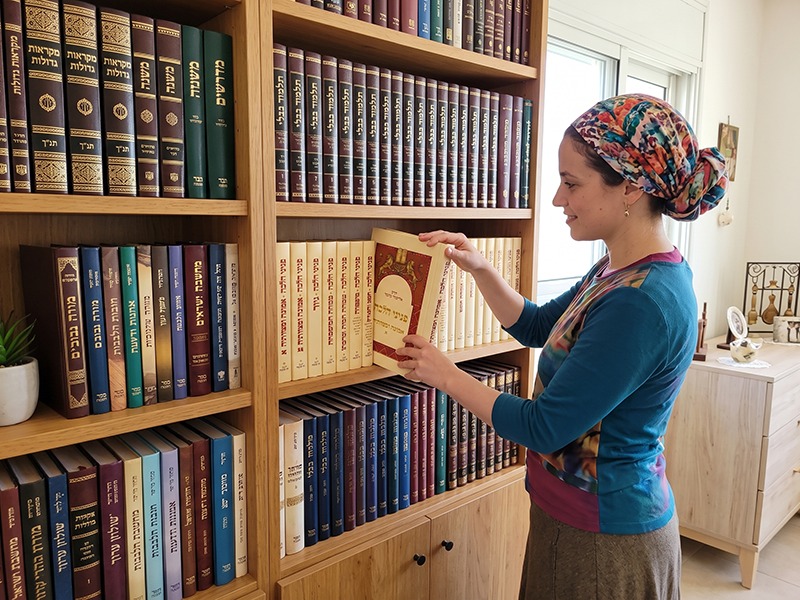
Women are obligated to study Torah, and the Torah belongs to women just as it belongs to men * At the foundation of the relationship with Torah, women even precede men * Only men are obligated to encompass the entirety of the Torah * Women, like men, are obligated to recite the blessings over the Torah every day * As the years have passed, women’s participation in all fields of work and the sciences has increased * Women who live in modern society, while participating in the advancement of science and society, are obligated to study much more Torah
The Question of Torah Study for Women
Q: Is it true that women are exempt from the commandment to study Torah, and is it true that the Torah belongs to men, and not to women?
A: That is not true. Women are obligated to study Torah, and the Torah belongs to women just as it belongs to men. It is true, however, that men’s obligation is greater than women’s obligation, but at the foundation of the relationship with Torah, women even precede men.
The Similarities and Differences Between Men and Women Regarding the Commandment
There are two parts to the commandment of Torah study: the first is to know the Torah’s instructions for guiding one’s life. The second is to delve deeply into the Torah and encompass it in its entirety, beyond what is required for guiding one’s life.
In the first part, which is knowing the Torah’s guidance for life, women and men are equally obligated (Sefer Hasidim 313; Semak, in its introduction; Agur, Prayer 2; Rema, Yoreh De’ah 246:6; Levush 6; Rishon LeZion 1). Therefore, the Torah was given at Mount Sinai to all Israel, men and women alike, and as God said to Moses in preparation for the revelation at Mount Sinai: “Thus shall you say to the house of Jacob, and declare to the children of Israel. You have seen what I did to Egypt… And now, if you will indeed obey My voice and keep My covenant, you shall be My treasured possession among all the nations…” And all the people answered together and said, “Everything that the Lord has spoken, we will do” (Exodus 19:3–8). Moreover, with regard to this part of Torah, women come first, as our Sages expounded: “‘Thus shall you say to the house of Jacob’—these are the women; ‘and declare to the children of Israel’—these are the men” (Mekhilta, ad loc.).
The second part is to encompass the entire Torah, including both commandments related to the learner’s life and those that are not related to it, and to continue examining and scrutinizing the Torah. In this area, only men are obligated, as it is stated: “And you shall teach them to your children” (Deuteronomy 11:19). Our Sages expounded: “And not your daughters” (Kiddushin 29b). Nevertheless, a woman who volunteers to study beyond what is relevant to guidance for life fulfills a commandment and will be rewarded (Sotah 21a).
The Blessings over the Torah and the Assembly
Since women are obligated to study the Torah’s guidance for life, women, like men, are obligated to recite the blessings over the Torah every day. These are the blessings that must be recited before studying Torah (Shulchan Aruch, Orach Chayim 47:14; Bach 4; Magen Avraham 14; Shulchan Aruch HaRav 10; introduction to Responsa Beit HaLevi).
Our Sages also related (Sanhedrin 94b) that King Hezekiah intensified Torah study throughout Israel:
“What did he do? He drove a sword into the entrance of the study hall and said: ‘Anyone who does not engage in Torah study shall be pierced by this sword.’ They searched from Dan to Beersheba and did not find an ignoramus; from Gabbath to Antipatris, they did not find a boy or a girl, a man or a woman, who was not knowledgeable in the laws of ritual impurity and purity.”
Therefore, even at the Hakhel assembly, which took place every seven years, when all Israel gathered to hear the Torah, women participated just like men, as it is stated: “And Moses commanded them, saying: At the end of seven years, at the appointed time of the Sabbatical year, during the Festival of Sukkot, when all Israel comes to appear before the Lord your God at the place He will choose, you shall read this Torah before all Israel, in their hearing. Assemble the people—the men, the women, the children, and the stranger who is within your gates—so that they may hear and learn, and fear the Lord your God, and observe and perform all the words of this Torah” (Deuteronomy 31:10–12).
The Extent of the Obligation Depends on the Generation
In the past, when people had to devote all their time and energy to obtaining food, preparing it, maintaining the household, and caring for children, humanity was immersed in ignorance, and only a small percentage knew how to read. In those times, women learned the Torah’s guidance for their lives from what they heard from their parents and from the rabbis’ sermons on Sabbaths and holidays. Consequently, people did not make the same effort to teach girls to read as they did to teach boys. Only exceptional individuals delved deeply into Torah and became wise women and prophetesses.
In recent generations, in a process that heralds redemption, knowledge has spread throughout humanity. Many people learned to read and write, initially in Europe and in countries to which Europeans emigrated, and later throughout all countries. At first, men learned to read, and later women did as well, until today, nearly 90 percent of adults worldwide know how to read. In the process, even women who manage their households and raise their children are exposed to different opinions on matters of faith, society, family, and human nature. A general knowledge of Torah and practical guidance for observing the laws of the home are no longer sufficient for them.
In addition, in the past, women needed to devote all their time and energy to housework and caring for children. However, as a result of technological progress, household tasks became easier, and many women began to acquire an education, work in all professions, participate in academic study and research, and become full partners in public life and its leadership. In the process, women are exposed to additional questions in every area of life. Therefore, women are obligated to study much more Torah than in the past.
The Words of the Chofetz Chaim and the Rabbis of Eastern Europe
Rabbi Yisrael Meir Kagan (the Chofetz Chaim, 1838–1933) wrote that, now that tradition had weakened, many girls did not live near their parents and were studying the sciences in schools, “it is certainly a great commandment to teach them the Five Books of Moses, as well as the Prophets and the Writings, and the ethical teachings of the Sages, such as Tractate Avot and the book Menorat HaMaor and the like, so that the matter of our holy faith will become firmly established in them. For otherwise, they may completely depart from the path of the Lord and, God forbid, violate all the foundations of the religion” (Likutei Halachot, Sotah 21a, in the note).
He also wrote in a letter of encouragement to a girls’ school (quoted in The Chofetz Chaim and His Work, vol. 3, p. 813): “And all the concerns and doubts regarding the prohibition against teaching Torah to one’s daughter are of no concern whatsoever in our times…”
During that period, with the support of the great Torah authorities, educational institutions dedicated to girls were established at a high level of Torah learning. One example is the Beit Yaakov network, founded by Mrs. Sarah Schenirer in 5678 (1918), with the support of the leading rabbis of Poland.
Similarly, Rabbi Zaken Aharon wrote in his responsa (2:66), in 5698 (1938), that it was permissible to redirect a donation to a Torah study institution to the Beit Yaakov school, since everything taught there for the purpose of preserving Judaism constituted a great commandment. Rabbi Tzirelson wrote similarly (Responsa Lev Yehudah, Yoreh De’ah 56).
Rabbi Sorotzkin wrote similarly (Moznayim LaMishpat 42) regarding the study of the Oral Torah at Beit Yaakov, and he even emphasized that today this is not merely permission but an “absolute obligation.” The same was written by Rabbi Waldenberg (Tzitz Eliezer 9:3), Rabbi Malka (Mikveh HaMayim, vol. 3, Yoreh De’ah 21), Rabbi Chaim David HaLevi (Aseh Lekha Rav 2:52), and Rabbi Eliyahu (Ma’amar Mordechai, vol. 1, Yoreh De’ah 11).
Rabbis of the Modern World
Naturally, as the years passed, especially in modern societies, women’s participation in all fields of work and the sciences increased, and consequently, rabbis instructed that more Torah study should be provided for women.
Thus, the Rebbe, Menachem Mendel Schneerson of Lubavitch instructed in a talk (At Alit, pp. 45–46) that since women “go out of their homes and receive influences from outside, etc., it is necessary to establish educational institutions for them in which they will receive a proper religious education… They must be taught the Oral Torah, not merely the study of definitive practical laws without their reasons, but also the reasons for the laws, extending to the give-and-take of Torah discussion. It is human nature, whether male or female, to desire and take greater pleasure in this kind of study, through which their senses and abilities will develop… in the spirit of our holy Torah…”
Rabbi Soloveitchik likewise instructed (Peninei HaRav, p. 167): “Today, in an era in which women are equal to men both in academia and in politics, women will not agree to conduct themselves according to the Torah if its subject matter is not understood by them from its sources in Scripture and the Talmud. We must permit them to study the Oral Torah… And if girls do not learn the foundations of the Torah from the Five Books of Moses and from the Talmud with the commentaries of the early authorities, then, God forbid, our authentic Judaism will come to an end.”
Nevertheless, there were rabbis in the previous generation who objected to the permission granted to teach Torah to women, maintaining that only definitive practical laws could be taught to them (Divrei Yatziv, Yoreh De’ah 139–140; Shevet HaLevi 6:150). Some prohibited teaching them Mishnah (Igrot Moshe, Yoreh De’ah 3:87; comments of Rabbi Yosef Shalom Elyashiv on Sotah 21b).
What these rabbis had in common was that they lived in a society that advocated distancing itself from modernity. They therefore believed that relatively simple instruction was sufficient, even though this was incomparably more extensive than what had been customary approximately 200 years earlier, when girls did not attend school and did not learn to read.
However, women who live in modern society and participate in advancing science and society, are obligated to study much more Torah.
The Obligation of Women to Study in Our Times
Therefore, in order to know how to live according to the Torah today, and to understand its guidance in matters of faith and ethics, the individual, the family, and society, women are obligated to broaden and deepen their study of Torah and halakha, while understanding the internal logic of the Torah, as explained in the Talmud and its commentators.
This obligation includes studying, in general, even commandments that do not have practical relevance, in order to understand the Torah’s overall vision. It is also obligatory to study the foundations of faith and the history of the revelation of faith through Israel, as explained in the Bible and in the writings of our Sages, the early authorities, and the later authorities, in order to understand the moral and idealistic vision contained in the Torah for the improvement of the world.
The more capable a woman is in Torah study, the greater the challenges before her; correspondingly, she must deepen her Torah learning even further.
In the “Peninei Halakha” series, I have endeavored to offer a way to fulfill the obligation incumbent upon men and women alike, at a breadth and depth that seem appropriate to me. However, regarding commandments that are specific to men, such as tefillin and tzitzit, it is sufficient for women to study the laws that explain the general principles of each commandment.
It follows that, in practice, since the obligation to study halakha, faith, and ethics has expanded considerably, the difference between men’s and women’s obligations has narrowed. Moreover, most men today do not manage to study even all the material that women themselves are obligated to learn.
With God’s help, in the next column I will write about the voluntary mitzvah for women of continuing to examine and delve more deeply into Torah and the Talmud, the problems that have arisen concerning this matter in the past and today, and the solutions.
This article appears in the ‘Besheva’ newspaper and was translated from Hebrew.