
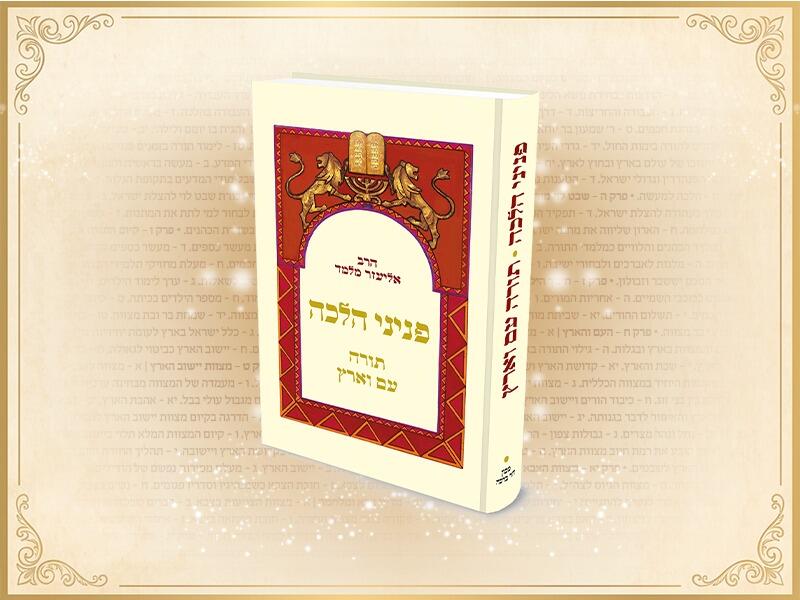
With God’s help, my new book, “Torah, Nation, and Land”, has been published as part of the ‘Peninei Halakha’ series * I have come to realize that, for many people, the Torah’s guidance concerning Torah study, work, science, settling the Land of Israel, and military service is not sufficiently clear, or properly grounded *
Following a meeting with rabbis in the United States, I reached the decision to create this book, in order to explain the Torah’s complete worldview regarding life *
The aim of this book is to explain that the Torah is our life and the length of our days, and that blessing for the life of the Jewish people in their Land flows from it, from which blessing will continue to flow toward the rectification of the entire world
With God’s help, last week my new book, “Torah, Nation, and Land“, was published as part of the ‘Peninei Halakha‘ series. Although this book is composed of two sections that until now appeared in the ‘Likkutim’ volumes, the halachot in it have been upgraded and expanded into one comprehensive work presenting the overarching idea of Torah, Nation, and Land, through to its practical expression in life and halakha.
The idea presented in the book demonstrates how, from the study of Torah, guidance and blessing flow to the people and the Land, in education, work and science, settlement, and military service. It also demonstrates how, through involvement in building the nation and the Land, the Jewish people gain a much deeper and truer understanding of the Torah, and consequently, through a gradual process, merit to fulfill the mitzvot in accordance with the Torah’s guidance, according to which the primary fulfillment of the mitzvot is in the Land of Israel.
The Dilemma Regarding Writing the Book
Initially, the subjects of Torah study were explained in general and briefly in ‘Likkutim I’, while the subjects of the nation and the Land were explained in greater detail in the ‘Likkutim’ volume “The Nation and the Land”.
Since most of the subjects in ‘Likkutim I’ were clarified and upgraded in “Peninei Halakha: Chefzei Kodesh”, which was published in Iyar 5786, only the chapters concerning the Torah remained on their own.
I had two options before me. One was to combine the halachot concerning the Torah, as they stood, with the halachot in the ‘Likkutim’ volume “The Nation and the Land“, maintaining the level of the ‘Likkutim’, and then continue to the additional areas that I had planned to study and write about, including the value of life, medicine, safeguarding the body, and from there, finally reach the important and extensive subject of interpersonal relationships.
The other option was to fulfill an equally important goal: to expand upon the mitzvah of Torah study, with an emphasis on its connection to the nation and the settlement of the Land of Israel.
With either option, I would have continued pursuing the general goal of transferring the halachot in the ‘Likkutim‘ volumes into complete books.
The Decision in Favor of Torah, Nation, and Land
Over the past several years, following meetings with rabbis and educators, I have come to realize that, for many people, the Torah’s guidance concerning Torah study, work, science, settling the Land of Israel, and military service is not sufficiently clear or properly grounded.
About a year ago, I traveled to the United States to deliver lectures and meet with rabbis. On a Thursday evening, at the B’nai Jeshurun synagogue in Teaneck, during a meeting with rabbis, a discussion arose about the challenges facing Torah education. A problem was raised in particularly forceful terms: On the one hand, it is clear that according to the Torah, work and science, as well as maintaining a connection with all members of our people, have great value. On the other hand, many people perceive these things as being outside the realm of Torah. Therefore, there is a need to establish a sound, Torah-based foundation for our position regarding them.
I do not know what influenced me more at that meeting: perhaps it was the distance from the Land of Israel, or the disruption of my regular study schedule. In any event, following that meeting, I reached a firm decision to create the book “Torah, Nation, and Land“, in order to explain the Torah’s complete worldview regarding life.
Thus, after completing, with God’s help, the writing of “Chefzei Kodesh”, I continued to delve deeply into the mitzvah of Torah study and the relationship between Torah and derech eretz (worldly pursuits and proper conduct), settling the Land of Israel, military service, and science. With God’s help, and the assistance of the rabbis of the institute, I merited to explain these subjects extensively, grounding them in their sources in the Torah and in the words of our Sages, the Rishonim, and the Acharonim.
The Crisis, the Mistakes, and the Need for Clarification
In light of this, I wrote the following in the Preface:
“According to the straightforward understanding that emerges from Torah study and the tradition of Israel, work and science, settling the Land of Israel, and building the nation have great value. However, as a result of the many upheavals in recent generations, including the challenges of modernity, the Holocaust, and the destruction of most of the communities of the Diaspora, and the establishment of the State of Israel under the leadership of Jews who had distanced themselves from religion, a mistaken notion took root among many people: that the Torah is unrelated to national and practical life, and that it does not bring blessing and rectification to life in this world.
As a result, on the one hand, many people distanced themselves from the Torah and its mitzvot and were swept along by partial ideologies such as liberalism, socialism, and nationalism. On the other hand, out of anxiety over preserving tradition, many withdrew into the study of only part of the Torah and the observance of only some of the mitzvot, while alienating themselves from the many mitzvot connected to the nation and the settlement of the Land, to derech eretz and society, and ignoring the great vision contained in the Torah – of bringing additional blessing and rectification to Israel, and the world.
“The aim of this book is to explain that the Torah is our life and the length of our days, and that blessing for the life of the Jewish people in their Land flows from it, from which blessing will continue to flow toward the rectification of the entire world. To this end, I have expanded upon the explanation of the mitzvah of Torah study, and in its light, have explained the value of work and science, as well as the way to impart Torah to the Jewish people. From this, the great mitzvot connected to the nation and the Land have also been clarified, through which the word of God is revealed to the world, and through which, we will merit the redemption of Israel and the rectification of the world.”
The First Chapters
In practice, the first seven chapters are entirely new.
The first chapter deals with the value of the Torah and the great virtue of those who study it, for they sustain the world, and through their genuine innovations, the world advances and rises to a higher level. From this, the relationship between study and practice is explained, as well as the meaning of studying Torah for its own sake, and the blessing that it brings to the person who studies it.
Following this, the second chapter deals with the definition of the obligation to study Torah, as explained in the Talmud, by the Rishonim and the Achronim. It emphasizes that the first obligation is for young students to learn how to live lives of Torah, and from this foundation, they will be able to add goodness and blessing to all their endeavors throughout their lives.
Continuing this discussion, the third chapter deals with the relationship between Torah and derech eretz. It explains the religious and moral value of work, earning a livelihood, and industriousness as part of the mitzvah of walking in God’s ways. Although I generally prefer brevity, I expanded this chapter more than usual in order to explain just how fundamental the attitude toward work is in the Torah, in halakha, in the stories of the Patriarchs, and in the deeds of our Sages.
The fourth chapter deals with the relationship between Torah and science, which is like the relationship between the Holy of Holies and the sacred. Within this discussion, the mitzvah of studying science is explained, both for the purpose of acquiring the foundation needed to learn a profession and for understanding the wisdom inherent in creation. The Vilna Gaon said that whatever a person lacks in one area of the secular sciences, he lacks a hundredfold in Torah knowledge in that corresponding area.
On this basis, it is explained that incorporating scientific studies into the curriculum, as is customary in religious high schools (yeshivot tichoniyot), is, in principle, the correct approach according to the Torah.
The Fifth Chapter: The Tribe of Levi – Teachers and Warriors
The fifth chapter, on the Tribe of Levi, is of particular importance. It refutes the mistaken notion that members of the Tribe of Levi were secluded in the study hall, withdrawing from the affairs of this world and national matters. In reality, they were the guardians of the sacred trust: the Torah, the people, and the Land.
Therefore, in addition to their service in the Temple, they were the teachers and officers who enforced the law! They were also responsible for military conscription, and after completing the organization of the army, they themselves would enlist in the army, just like the other tribes.
Whenever the army of Israel encountered difficulties, it was they who went out to fight, as they had done in the wilderness. This was also the case with Benaiah son of Jehoiada the priest, who served as commander of the army in the days of King Solomon, and with the Hasmonean priests, who saved Israel in the days of the Second Temple.
The Hesder Yeshivot
During the three years that we have been at war, students of the Hesder yeshivot have been serving in both regular and reserve military service. They are the modern-day successors of the Tribe of Levi.
This is especially true of the graduates who dedicated their lives to education and teaching Torah, and who, when called up for reserve duty, left their families and students and went out courageously to defend the people and the Land.
In the introduction to the book, I wrote:
“With sacred reverence, I dedicate this book to the elevation of the souls of those who continue the legacy of the Tribe of Levi in our generation. They are the dear rabbis and educators who dedicated their lives to teaching Torah to the Jewish people, and when the ‘War of Redemption’ broke out, went to the front lines to fight a milchemet mitzvah, a commanded war, to defend the people and the Land, and gave their lives in sanctification of God’s name.
“Among them are Rabbi Avi Goldberg, of blessed memory; Rabbi Aviram Hariv, of blessed memory; Rabbi Yossi Hershkowitz, of blessed memory; Rabbi Neren Ashchar, of blessed memory; and many others like them.
“May it be God’s will that the Almighty comfort the families of these kedoshim (holy martyrs), assist them in continuing the legacy of these heroes, and may they merit to bring additional blessing to their families and to all of Israel.”
The Teachers and Rabbis
The sixth chapter is devoted to the livelihood of rabbis and educators, from the period when the priests and Levites fulfilled these roles, until our own times.
The seventh chapter deals with education itself. In it, I have made every effort to express the great stature of male and female teachers. They are like the stars in the heavens, carrying the great light onward into the hearts of their students. They cleave to the attribute of the Holy One, blessed be He, and are the modern-day successors of the Tribe of Levi. The entire House of Israel rests upon them.
The greatness of their reward in the World to Come cannot be estimated. Even in this world, if they merit to rejoice in their portion, they will merit abundant satisfaction and blessing.
The Chapters on the Nation and the Land
As a direct continuation of the chapters dealing with the Torah and its purpose of bringing the word of God and His blessing to the world, the second part of the book deals with “Nation and Land.”
Chapter 8 explains how faith and Torah are revealed through the nation and the Land.
Chapters 9–10 explain the mitzvah of settling the Land of Israel within its borders.
Chapters 11–12 are devoted to the mitzvah of serving in the army.
Chapter 13 explains the mitzvah of safeguarding the Land that God bequeathed to our forefathers and to us, and of not abandoning it to another nation.
Chapter 14 deals with the obligation to uphold the law, and improve the system of justice.
This section is an upgraded version of the ‘Likkutim’ volume “The Nation and the Land”. However, only the ideas and halachot directly connected to the overall framework of “Torah, Nation, and Land” have been retained, while the halachot that were more closely related to social matters have been omitted. With God’s help, they will be explained extensively in a book devoted to matters of the state and the public.
In this context, the book also omits the responsa of Rabbi Shlomo Goren, of blessed memory, which he wrote to me personally, which is being published as a separate booklet. Perhaps on another occasion I will relate how, for me, publishing them was a sacred obligation to our rabbi, who devoted his life to the Torah, the people, and the Land.
The Final Chapter
The concluding chapter, “The Sacred and the Building of the Nation,” returns to unite the two parts of the book. It explains the crises that have occurred and continue to occur when the Torah does not guide the nation and the settlement of the Land, and the tremendous blessing that comes from bringing them together, as was the case from the days of Joshua son of Nun, the Prophet Samuel, and Ahab, through to our own times.
From this, the book concludes with the necessity of returning to the sacred, and with the connection between the mitzvah of procreation, the settlement of the Land of Israel, and redemption.
This article appears in the ‘Besheva’ newspaper and was translated from Hebrew.