

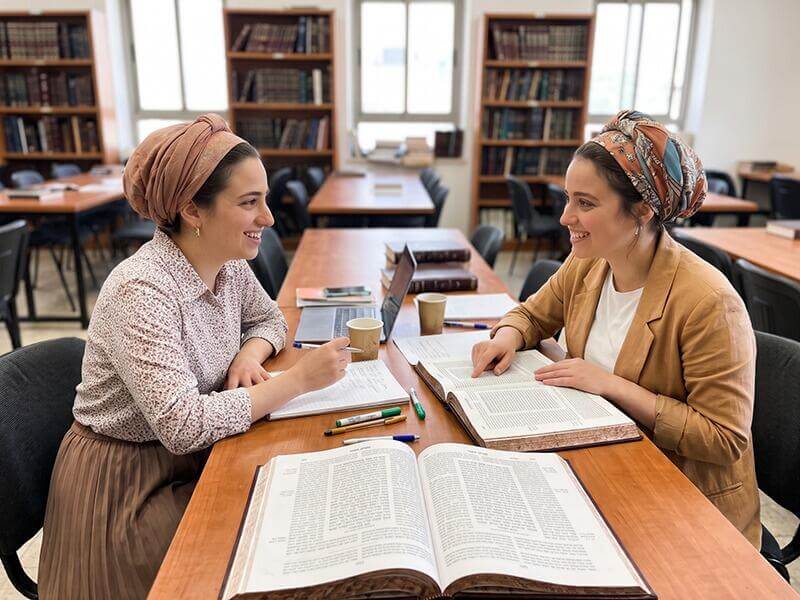
Women are obligated to broaden and deepen their study of Torah and halakha, while understanding the internal logic of the Torah as it emerges from the Talmud and its commentators * This obligation includes studying, in a general way, even commandments that do not have practical application * The early authorities ruled that a daughter should not be taught Torah, lest through her studies she come to declare permitted things that are forbidden * However, a woman who wishes to study on her own is permitted to study the Written Torah and the Oral Torah in depth, and she receives reward for doing so * Throughout the generations, there have been women who studied Torah and attained a high level of proficiency in it
Women’s Study of the Talmud
Q: Is it good for a woman to study Gemara in depth? Is it right to encourage this, or is there merit to the claim made by some that it is undesirable because it undermines tradition, and may lead to a weakening of commitment to the observance of the commandments?
A: First, it must be explained that the commandment to study Torah has two components. The first is to know the Torah’s instructions for guiding one’s life, and in this respect men and women are equally obligated. The second is to encompass the entire Torah, including commandments related to the learner’s life and those that are not, and to continue examining and analyzing the Torah in depth. In this respect, only men are obligated, as will be explained below.
Women’s Obligation to Study Torah for Guidance in Life, in the Past and Present
In the past, when people had to devote all their time and energy to obtaining food, preparing it, maintaining the household, and caring for children, humanity was immersed in ignorance, and only a small percentage of people knew how to read. In those times, women learned the Torah’s guidance for their lives from what they heard from their parents and from the rabbis’ sermons on Shabbat and holidays. Consequently, people did not make the same effort to teach girls to read as they did to teach boys. Only exceptional individuals delved deeply into Torah and became learned women and prophetesses.
In recent generations, however, living conditions have improved and knowledge has spread throughout humanity, to the point that nearly 90 percent of adults worldwide can read. In this context, many women have begun to acquire an education, work in every profession, participate in academic study and research, and become full partners in public life and its leadership. The challenge of continuing to bring God’s word and blessing to the world has consequently become far more complex. Even women who manage their households and raise their children are exposed to different opinions concerning faith, society, family, and human nature, and a general knowledge of Torah is no longer sufficient for them.
Therefore, in order to know how to live according to the Torah today, and to understand its guidance in matters of faith and morality, the individual, the family, and society, women are obligated to broaden and deepen their study of Torah and halakha, while understanding the internal logic of the Torah as it emerges from the Talmud and its commentators. This obligation includes studying, in a general way, even commandments that do not have practical application, in order to understand the Torah’s overall vision.
Likewise, women are obligated to study the foundations of faith and the history of the revelation of faith through Israel, as explained in the Bible and in the teachings of our Sages, the early authorities, and the later authorities, in order to understand the moral and idealistic vision of the Torah for perfecting the world. The more capable a woman is in Torah study, the greater the challenges she faces, and correspondingly, the more deeply she must study the Torah.
Study That Is Not Intended to Guide One’s Life
Regarding Torah study that is not necessary for the observance of a Torah-oriented life, the Tannaim disagreed. It is explained in the Mishnah Sotah (20a) and the Gemara (there, 21a) that, according to Ben Azzai, “A man is obligated to teach his daughter Torah,” and this is the opinion expressed anonymously in that Mishnah. In contrast, Rabbi Eliezer maintains, “Anyone who teaches his daughter Torah teaches her frivolity,” and Rabbi Yehoshua agrees with him. The Jerusalem Talmud, Sotah (3:4), further explains that according to Rabbi Elazar ben Azariah, it is a mitzvah for women to hear the Torah, but not to study it in depth.
In practice, the early authorities ruled that one should not teach a daughter Torah, lest through her studies she come to declare permitted things that are forbidden. This is the position expressed by Rabbeinu Chananel, Rashi, Maimonides (Laws of Torah Study 1:13), Rabbi Ovadiah of Bertinoro (Sotah 3:4), and many others. However, according to the Ri’az (Sotah 1:2), a father is permitted to teach his daughter the Oral Torah, although he is not obligated to do so.
In other words, because women do not have the time and conditions necessary to study the Oral Torah with the seriousness and depth required, there is concern that a woman may misunderstand and misinterpret the Torah. Our Sages did not command that daughters be kept from all Torah study. Rather, only those who were especially suited to it, and particularly wished to pursue it, were taught Torah, as will be explained below.
Incidentally, this caution also applies to men. Someone who is not prepared to study with the seriousness and humility required is considered an unworthy student, and should not be taught Torah before correcting his ways.
The Difference Between the Written Torah and the Oral Torah
In principle, the instruction not to teach a daughter Torah beyond what is needed to guide her life applies to both the Written Torah, and the Oral Torah. However, our Sages’ statement, “Anyone who teaches his daughter Torah teaches her frivolity,” applies to the Oral Torah, not the Written Torah, as Maimonides writes (Laws of Torah Study 1:13):
Our Sages instructed that a person should not teach his daughter Torah, because most women are not mentally disposed to study, but instead turn the words of Torah into matters of nonsense, according to the limitations of their understanding. Our Sages said: “Anyone who teaches his daughter Torah teaches her frivolity.” To what does this refer? To the Oral Torah. But the Written Torah should not be taught to her initially; if he did teach her, it is not as though he had taught her frivolity.
This ruling is also established in the Shulchan Aruch (Yoreh De’ah 246:6).
The reason for this distinction is that the concern about turning words of Torah into nonsense applies to the study of the Oral Torah, in which one learns methods of analysis and logical reasoning, but not to the Written Torah (Sefer Mitzvot Gadol, positive commandment 12; Responsa of the Mahari”l HaChadashot 45).
The Taz (246:4) adds that the initial prohibition concerning the Written Torah applies to studying it in depth, which may lead to incorrect understandings. However, studying it for broad familiarity, without claiming to understand and interpret it, is permitted even initially. This position is also expressed in Tzitz Eliezer 9:3 and Bnei Banim 3:12.
A Woman Who Wishes to Study Gemara Has a Mitzvah
Everything discussed thus far concerns parents and rabbis, whom our Sages instructed not to teach daughters Torah beyond what is necessary to guide their lives. However, a woman who wishes to study on her own is permitted to study the Bible and the Oral Torah in depth, and she receives reward for doing so.
Maimonides writes accordingly (Laws of Torah Study 1:13):
“A woman who studied Torah receives reward, but not the same reward as a man, because she was not commanded to do so. Anyone who performs an act that he was not commanded to perform does not receive the same reward as one who performs it because he was commanded, but rather less.”
The reason there is no flaw in a woman’s decision to study Gemara independently is that, since she has voluntarily chosen to study and delve deeply into Torah for the sake of Heaven, there is no concern that she will wish to turn the words of Torah into frivolity.
This is what the Mahari”l writes (HaChadashot 45), one of the greatest Ashkenazic rabbinic authorities at the end of the period of the Rishonim. Rabbi Shmuel Archivolti writes similarly in Responsa Ma’ayan Ganim 10, as does Rabbi Yehoshua Falk Katz in Perishah, Yoreh De’ah 246:15. They explain that by choosing to study independently, she has demonstrated that she belongs to the minority capable of studying properly, and she therefore deserves merit for doing so. Maran Rabbi Abraham Isaac Kook expresses the same view in Igrot HaRa’ayah 2:467.
Learned Women Can Issue Halakhic Rulings
For this reason, throughout the generations there have been women who studied Torah and attained a high level of proficiency in it.
The Chida writes (Tov Ayin 4) that if a father sees that his daughter genuinely wishes to study, he is permitted to teach her. Rabbi Yehuda Assad (Yehuda Ya’aleh 1, Yoreh De’ah 48) writes that a woman who wishes to do so may study the laws of ritual slaughter. This is also stated in Tzitz Eliezer 9:13.
Moreover, the Chida writes in Birkei Yosef, Choshen Mishpat 7:12:
“A learned woman can issue halakhic rulings.”
The Sefer HaChinuch (commandment 152) likewise states, in connection with the prohibition against issuing rulings while intoxicated with wine, that this prohibition also applies to “a learned woman qualified to issue rulings.”
The Practical Problem
Nevertheless, a practical difficulty remains: Talmud study requires a high level of skill and broad knowledge of Torah. Without these, a learner is likely to make mistakes by developing incorrect lines of reasoning.
For this reason, boys study for many hours in the study hall, and only after many years, do they learn to formulate arguments that can be accepted in halakhic decision-making. Even then, they initially do so through discussion with experienced halakhic authorities, gradually adding their own contributions as they progress.
Since it is difficult for women to reach the required level without investing the same amount of time, without a study hall, and without the apprenticeship under Torah scholars that such learning requires, there is concern that they may advance incorrect arguments.
A Gradual Solution
In any case, now that women’s obligation to study Torah has expanded considerably, it is agreed that one must first study the commandments of the Torah and their laws, together with their reasoning and underlying explanations, as well as the foundations of faith and morality.
This applies to men, who are obligated to study the Talmud, and all the more so to women, who are not obligated to do so.
After broadly and thoroughly studying all the commandments and halakhic laws, the concern that Talmud study will be conducted incorrectly is reduced, although it does not disappear. Therefore, women who study Talmud must remember that studying the Talmud at a basic level, or without receiving the traditions of the study hall, may lead to incorrect understandings.
By contrast, when halakha is studied thoroughly, together with the refined reasoning that emerges from the Talmud and its commentators, there is almost no concern of error.
A woman who repeatedly reviews her halakhic studies will be able to serve as a good teacher of halakha, capable of answering the vast majority of halakhic questions that arise in a person’s life. On the foundation of a solid knowledge of halakha, faith, and morality, women who wish to do so will then be able to continue advancing in Talmud study until they reach the highest possible level.
The Vision for the Future
Although the obligation for women to study Torah has expanded considerably, a fundamental distinction between men and women remains: men must study Torah also because of their obligation, whereas women should engage in Talmud study out of freedom and desire. In this way, through the combination of obligation and desire, the people of Israel will be built up (see Peninei Halakha: Women’s Prayer, chapter 3, and Simchat HaBayit U’Virchato, chapter 10).
Ultimately, as the generations continue to advance, the vision is for women to study a great deal of Torah. As Maimonides explains (Foundations of the Torah 4:14), every person is commanded to love God and fear Him, and the way to attain love and fear of Him is through Torah study. This begins with the discussions of Abaye and Rava, and with knowledge of what is permitted and forbidden in all the commandments, and continues with the study of the account of Creation and the Divine Chariot.
Maimonides writes concerning these subjects:
“For they are the great good that the Holy One, blessed be He, bestowed upon the world to sustain it, so that one may inherit the World to Come. And it is possible for everyone to know them: the great and the small, men and women, those with broad minds and those with limited minds.”
Rabbi Nachum Rabinovitch makes this point in his commentary Yad Peshutah.
This accords with the words of the prophet (Joel 3:1–2):
“And it shall come to pass afterward that I will pour out My spirit upon all flesh, and your sons and your daughters shall prophesy… And also, upon the male and female servants in those days, I will pour out My spirit.
This article appears in the ‘Besheva’ newspaper and was translated from Hebrew.