

Tefillin are a sign for Israel—that is, a symbol and marker that expresses their very essence * The passages of the tefillin express the foundations of faith * One of these foundations is the centrality of the Land of Israel, which is mentioned many times in the tefillin * Like the mitzvah of settling the Land of Israel, the mitzvah of tefillin binds holiness to physical reality *The commandment to bind tefillin on the arm and the head expresses the absolute bond between the people of Israel, God, and His Torah * Even if a person grows his hair like a lifelong Nazirite, his hair does not constitute a barrier
The Reason for the Mitzvah of Tefillin
Tefillin are an ote (a sign) for Israel—a symbol and marker that expresses their essence. They have a dual expression. On the one hand, they express our status as servants subjugated to the Master of the universe; we declare this servitude by placing tefillin on our bodies, similar to servants who would carry their master’s symbol upon them. On the other hand, they are also Israel’s glorious crown, for they express Israel’s unique ability to connect to God and reveal His Name in the world. Precisely through complete servitude to God, we become truly free—released from the chains of this world—and merit sanctification, being adorned with the crown of God’s kingship, and revealing His Name in the world.
Tefillin and the Land of Israel
The passages of the tefillin express the foundations of emunah (faith), and one of these foundations is the Land of Israel, which is mentioned many times in the tefillin. In the passage of Kadesh:
“And it shall be when the Lord brings you into the land of the Canaanite, the Hittite, the Amorite, the Hivite, and the Jebusite, which He swore to your fathers to give you, a land flowing with milk and honey” (Exodus 13:5).
In the passage of Vehaya Ki Yeviacha:
“And it shall be when the Lord brings you into the land of the Canaanite, as He swore to you and to your fathers, and gives it to you” (Exodus 13:11).
The passage of Vehaya Im Shamoa deals entirely with the Land of Israel, for all the reward and punishment mentioned in it—and in the entire Torah—are realized primarily in the Land of Israel. And in the passage of Shema, the belief in the One God is mentioned; as we have learned, the primary revelation of the faith in God’s unity, is in the Land of Israel.
The mitzvah of tefillin, like the mitzvah of settling the Land of Israel, binds holiness into physical reality. We are commanded to write the sacred passages of the tefillin on animal hide and to place them in cases made of animal hide, to teach that even the animalistic aspects are connected to holiness. This is what our Sages said: “Fulfill this mitzvah (tefillin), for because of it, you will enter the Land” (Kiddushin 37b).
Like the Land of Israel, tefillin express the intrinsic bond between Israel and God. Therefore, tefillin are bound on the head and the arm, to express that we are truly bound to the Divine destiny. Our Sages said (Berakhot 6a) that even the Holy One, blessed be He, dons tefillin, and it is written in God’s tefillin: “And who is like Your people Israel, one nation on the earth” (I Chronicles 17:21).
Tefillin Reveal the Soul Within Us
Due to the distractions and temptations of this world, a person may sink into immediate needs, and fleeting desires. By binding tefillin, which contain the foundations of faith and Torah, we reconnect to faith and the eternal ideas of the Divine Torah, and the soul within us is revealed. As our Sages said: “Anyone who dons tefillin lengthens his days, as it is stated: ‘The Lord—by them, they shall live’” (Isaiah 38:16; Menachot 44a).
Tefillin and the Mitzvah of the Firstborn
Q: It is clear that the passages of the tefillin express the foundations of Israel’s faith, and therefore we were commanded to write specifically these passages and place them in the tefillin. If so, what is the connection between the mitzvah of the firstborn and the foundations of faith, such that it is mentioned at length both in the passage of Kadesh and in Vehaya Ki Yeviacha?
A: The mitzvah of sanctifying the firstborn expresses the basic belief that everything begins with God. To extend God’s word into the world, one must sanctify the beginning of all things: the firstborn of a person, the firstborn of an animal, and even the firstborn of a donkey, which is a non-kosher animal. Similarly, the Torah commands us to bring the first fruits that grow each year as bikkurim to God. Likewise, we are commanded not to eat the fruit of a tree during its first three years (orlah), and to sanctify the fruit of the fourth year (neta revai), which is like the first year of benefit from the fruit, to God.
Similarly, in childhood and youth, a person should study Torah, and from that foundation, go on to build a family and engage in yishuvo shel olam (settling the world). Likewise, the first city we conquered in the Land of Israel—Jericho—was consecrated to God.
By consecrating the firstborn to God, God’s blessing can extend to all creations, and all our actions in the world. The Exodus from Egypt is also the beginning of the people of Israel, when God’s choice of Israel as His treasured nation was revealed, to inherit His land, and reveal His word to the world. On the Seder night and on Passover, we remember this foundation; therefore, the mitzvah of the firstborn and the festival of Passover are mentioned in the first two passages of the tefillin.
The Meaning of Binding the Tefillin
The commandment to bind tefillin on the arm and the head expresses the absolute bond between the people of Israel, God, and His Torah. Many nations have spiritual ideas, but no nation’s ideas have endured immense and terrifying challenges over such a long period, as the Torah has endured within the people of Israel. There are two reasons for this. First, God chose Israel from among all nations and gave His Torah only to Israel; therefore, Israel’s ideas are Divine ideas, whereas the ideas of other nations are human ideas.
The second reason, which follows from the first, is that the bond of other nations to their ideas is not as deep and strong as Israel’s bond to the Torah. Therefore, there has never been a nation whose people were so willing to give their lives for their faith, as Israel. Nor is there a nation in which the Divine idea captures the hearts and minds of so many of its people.
These ideas are expressed by the mitzvah of tefillin, in which we literally bind the passages of the tefillin to the arm and the head. By doing so, we bind the primary human faculties—intellect, emotion, and action—to holiness. The arm tefillin correspond to the heart and the arm, symbolizing emotion and action; the head tefillin correspond to the intellect. In this sense, tefillin express the bond between Israel and God more than other mitzvot, because through tefillin, we bind the sacred ideas directly to our bodies, thereby becoming completely attached to God and His Torah.
Is It Permissible to Put Tefillin on a Wig?
Q: If a person has lost his hair and always wears a wig that looks like natural hair, and removing it would cause him great embarrassment, may he put the head tefillin on the wig?
A: According to the Rashba (Responsa 3:282), only the arm tefillin may not have a chatzitza (something that separates between the body and the tefillin), as it is written “‘for you as a sign’—and not for others as a sign,” but the head tefillin have no law of chatzitza, since they must be visible, as it is stated: “And all the peoples of the earth shall see that the name of the Lord is called upon you, and they shall fear you” (Deuteronomy 28:10). Therefore, according to this view, it is permitted to place them on a hat. This is also the opinion of the Ran.
However, according to most early authorities, even for the head tefillin, there may not be any chatzitza between the head and the tefillin (Responsa of the Rosh 3:4; Yere’im 399; Responsa of the Ritva 24; Tashbetz 1:30).
Practically, the poskim (Jewish law arbiters) ruled that a person who is under compulsion (onus) and cannot place the tefillin directly on his head, should place them on a hat without reciting a blessing (Responsa of the Rivash 137; Shulchan Aruch and Rema, Orach Chaim 27:4–5). Therefore, he should put on the tefillin with a blessing on his head at home before prayer, and in the synagogue place the tefillin on the wig without reciting a blessing.
Does Long Hair Constitute a Chatzitza for Tefillin?
Although the Machatzit HaShekel (27:4) wrote that one who grows long hair sins through arrogance and pride, and that there is concern that his hair constitutes a chatzitza for tefillin—and these words were cited in the Mishnah Berurah (27:15)—these views cannot be accepted. The law is that even if a person grows his hair like a lifelong Nazir (Nazirite) and has never cut it, his hair does not constitute a chatzitza. Otherwise, how could the Torah permit a person to be a lifelong Nazirite, if as a result of his hair growth he would be unable to fulfill the mitzvah of tefillin? Likewise, among mourners for parents, some refrain from cutting their hair for many months or even a year, and certainly they put on tefillin (Mor U’Ketziah; Aruch HaShulchan 27:14; Or LeTzion vol. 2, 44:19; Bnei Banim 1:6).
Chatzitza with the Straps
Ideally, one should also ensure that there is no chatzitza between the straps that bind and secure the tefillin to the arm and head. However, after the fact, a chatzitza under the straps does not invalidate the mitzvah, and the tefillin are put on with a blessing (Levush; Mishnah Berurah 27:16).
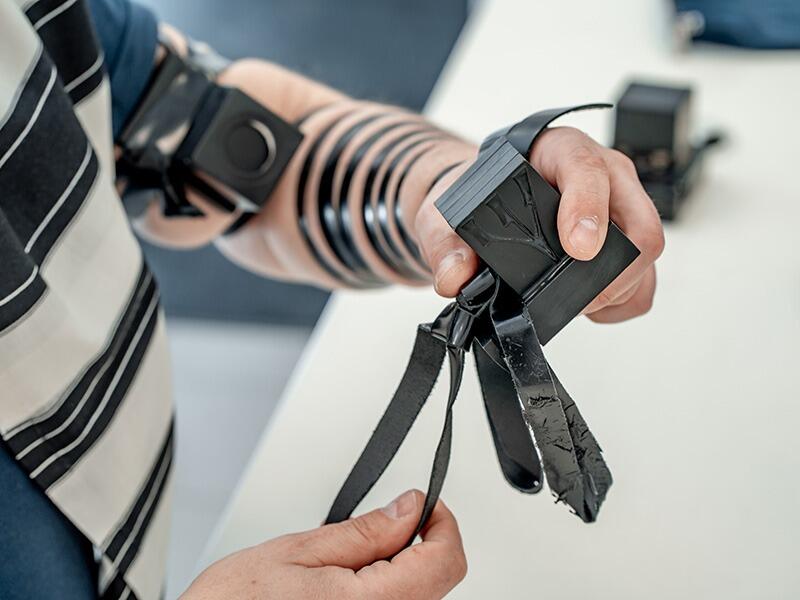
Regarding the straps that are wrapped for a hiddur mitzvah seven times around the forearm as an enhancement of the mitzvah, from a halachic standpoint a chatzitza is permissible, since they do not bind the tefillin to the arm. Nevertheless, many are meticulous to remove any chatzitza even from the place of the wrappings; therefore, it is customary to remove a wristwatch before putting on tefillin (Pri Megadim, Mishbetzot Zahav 4).
Must the “Yud” Knot Be Adjacent to the Arm Tefillin?
First, it should be explained that a knot in the shape of a “yud” must be made near the arm tefillin with the straps, and our Sages said: “The knot of tefillin is a halakha given to Moses at Sinai” (Menachot 35b). Some are careful to attach the “yud” knot tightly to the tefillin box (Mishnah Berurah 27:11), because the kabbalists, based on the Zohar (vol. 3, 276b), warned that the knot should be adjacent to the tefillin. However, from a strictly halachic standpoint, the attachment of the knot is not essential to fulfilling the mitzvah. Some poskim say that as long as the knot is near the tefillin—even if there is air between them—it is considered adjacent (Teshurot Shai 2:93). Others say it is sufficient that the knot be adjacent to the titura, which in practice always occurs (Avnei Nezer, Orach Chaim 14).
Those who follow Kabbalah, however, are more meticulous about attaching the “yud” knot closely to the tefillin. One of the reasons for wrapping the straps around the tefillin box according to the custom of the kabbalists is to attach the knot to the box (Birkei Yosef, Orach Chaim 25:9). Some are even more stringent and tie the knot to the tefillin box with sinew (Ben Ish Chai, Vayera 15). However, the accepted custom is not to add such bindings with sinews or the like.
This article appears in the ‘Besheva’ newspaper and was translated from Hebrew.