


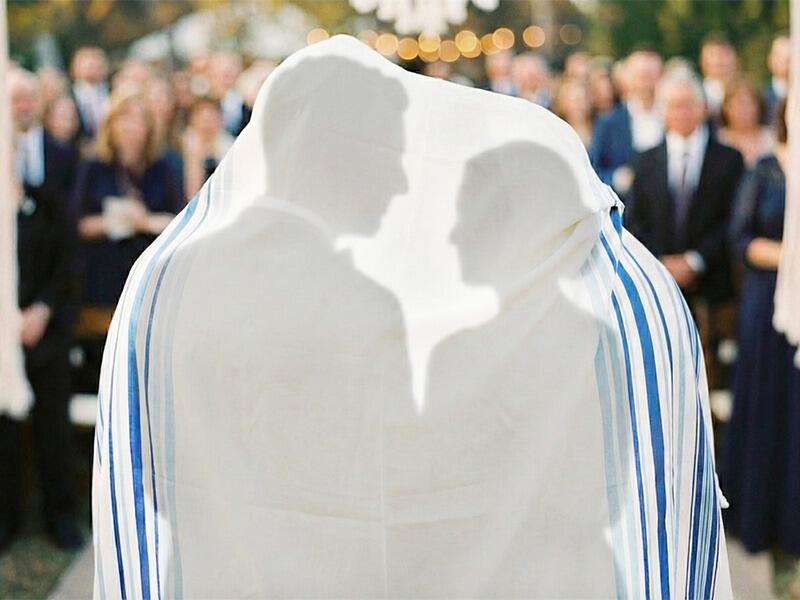
As a general rule, it is forbidden to participate in a wedding that is not conducted in accordance with halakha * Without a wedding according to the law of Moses and Israel, it is forbidden for a man and a woman to engage in marital relations * It is a mitzvah from the Torah to protest against one who commits a transgression * At the same time, one must strive to preserve good relationships with all members of the family * In a situation where a rift in the family is likely to be created, it is preferable to participate in the event to the minimal extent necessary * A scarf is exempt from tzitzit, since it is intended to cover the neck * One who is able should preferably fulfill the mitzvah of tzitzit with a wool garment.
The Prohibition Against Participating in a Non-Halakhic “Wedding”
Similar to the question discussed in the previous column regarding participation in an “intermarriage,” I will present another question in this area.
Q: A member of our family is getting married for the second time, but this time, it is a “civil wedding,” without cḥuppah and kiddushin. Is it permissible to attend if he is likely to be deeply hurt if we do not come?
A: As a general rule, it is forbidden to participate in a wedding that is not conducted according to halakha. According to Jewish law, it is a great mitzvah for every Jewish man to marry according to the law of Moses and Israel, and without such a wedding, it is forbidden for a man and a woman to engage in marital relations.
Moreover, it is a Torah commandment to protest against one who commits a transgression, as it is stated:
“You shall not hate your brother in your heart; you shall surely rebuke your fellow, and you shall not bear sin because of him” (Leviticus 19:17). All the more so, is it forbidden to participate in an event that is known to all to be contrary to the commandments of the Torah.
Indeed, in a place where rebuke will not be accepted, one should not rebuke, as our Sages said:
“Just as it is a mitzvah to say something that will be heeded, so it is a mitzvah not to say something that will not be heeded” (Yevamot 65b). However, participation in such an event is forbidden, since by participating one performs an act that contradicts the mitzvah of rebuke.
And even though there is no chance that the prohibited event will be canceled as a result of one’s non-participation, there is a chance that this will remind them of the prohibition, and perhaps one day they will try to correct it, or at least encourage their children to marry according to the law of Moses and Israel.
At the Same Time: Preserving Family Bonds
Nevertheless, at the same time, one must strive to preserve good relationships with all family members, which itself is a great mitzvah. Rabbi Akiva said of this mitzvah that it is a great principle of the Torah:
“You shall love your fellow as yourself” (Leviticus 19:18; Sifra ad loc.). And the closer the relatives, the mitzvah obligates one all the more.
In an ideal situation, family members respect one another. Just as they allow themselves to choose to act contrary to halakha, so too, they should understand that they must respect you for being unable to participate in a “wedding” that contradicts the tradition of Jewish faith.
If you fear that they may be hurt and think that your non-participation expresses a fundamentally negative attitude toward them, then before the event, give your relative a valuable gift that expresses your love for them, and express deep regret that you cannot attend. In this way, in the vast majority of cases, no real offense will be created, and the good relationship between you will remain intact—and may even be strengthened—when they realize that although you cannot attend their “wedding,” they are still very important to you.
When the Price Is a Family Rift
Q: What should be done when it is absolutely clear that if we do not attend, a deep rift will be created in the family, and there is concern that some relatives may refuse to speak with us for many years? Perhaps this is characteristic of a family like ours, which for several generations has not observed mitzvot, and only we have returned in repentance—so we are viewed as having separated from them?
A: In such a situation, it is preferable to participate in the event to the minimum extent necessary in order to prevent a family rift. For although, from the standpoint of the mitzvah of “you shall surely rebuke,” participation is forbidden, on the other hand, creating a family rupture would lead to many additional and more severe prohibitions of hatred and alienation within the family.
Such a rupture could also cause further distancing of your relatives from Jewish tradition. Therefore, it is preferable that you participate and express your love for your family members, while also expressing a certain degree of discomfort at being compelled to act contrary to the tradition of Jewish faith.
(This approach was written similarly by R. Shlomo Zalman Auerbach in Minḥat Shlomo I:35, as cited in Peninei Halakhah: Berakhot 12:12.)
Tzitzit on a Scarf, Turban, or Keffiyeh
Q: Is a large scarf with four corners obligated in tzitzit?
A: A scarf is exempt from tzitzit, since it is intended to cover the neck, whereas the garment obligated in tzitzit is the standard garment meant to cover the body. The same applies to a keffiyeh or a turban, which are exempt from tzitzit since they are intended for the head and neck, and not for covering the body (Shulḥan Arukh, Oraḥ Ḥayyim 10:11–12).
However, if it is a wide, large scarf that is sometimes wrapped around part of the body, some poskim maintain that it is obligated in tzitzit (Kaftor Va-Feraḥ §60). Others ruled that one should round one of its corners in order to exempt it from tzitzit (Artzot Ha-Ḥayyim 10:42).
Nevertheless, according to many authorities, even when part of the body is sometimes covered with a scarf, tzitzit should not be attached, since a garment intended for the head or neck is considered a “head-and-neck covering” and not a general garment, and is therefore exempt from tzitzit. This is the widespread custom
(Beit Yosef 10:10–11; Levush 10; and many others).
Those who wish to enhance the mitzvah should make one corner rounded, in which case it will be exempt from tzitzit according to all opinions
(Bi’ur Halakhah 10:10, s.v. “keivan she-ikarah”).
Stolen Tzitzit and Tax Evasion
Q: I bought tzitzit in a store, but after returning home, I realized that the seller did not give me a receipt, and I am concerned that he may be evading taxes. Are the tzitzit considered stolen and therefore invalid?
A: When tzitzit strings are stolen, the tzitzit are invalid, as it is stated:
“And they shall make for themselves tzitzit” (Numbers 15:38), from which our Sages derived: “for themselves”—from their own property (Sukkah 9a).
Even one who steals a tallit and attaches his own tzitzit does not fulfill the mitzvah, as it is stated: “your garment” (Bi’ur Halakhah 11:6, s.v. “im”).
Likewise, one who buys tzitzit from a thief cannot fulfill the mitzvah with them, and may not recite a blessing over them (Mishnah Berurah 11:30; 25:54).
However, if the seller does not pay taxes, then indeed one should ideally not buy from him, since he is stealing from the public, and the buyer becomes a partner in a transgression. But since the tallit itself is not stolen, it is permissible to recite a blessing over it. Additionally, after the fact, one is not obligated to suspect that the seller evaded taxes. Nevertheless, next time it is proper to request a receipt.
Morning Blessings on Tallit Katan and Tallit Gadol
Q: One who puts on a tallit katan in the morning and afterward a tallit gadol—must he recite a blessing on each one separately?
A: Those who put on a tallit katan in the morning and shortly thereafter, go to pray Shaḥarit and wrap themselves in a tallit gadol, should recite the blessing over the tallit gadol, and intend for it to cover the tallit katan as well.
However, if more than half an hour will pass before donning the tallit gadol, it is proper to recite a blessing over the tallit katan close to putting it on, and before beginning Shaḥarit, to recite a blessing over the tallit gadol.
Is It Necessary to Be Careful to Wear a Wool Tallit?
There has been a dispute dating back to the Amoraim as to whether all types of fabrics are obligated in tzitzit by Torah law (Menahot 39b). According to Rav Yehudah and Rava, every four-cornered garment of any fabric is obligated in tzitzit by Torah law, as it is stated:
“And they shall make for themselves tzitzit on the corners of their garments” (Numbers 15:38).
Many early authorities ruled accordingly
(Tosafot Menahot 39b s.v. “ve-Rav Naḥman,” in the name of Rashi and Rabbeinu Tam; Ri”d, Itur, Semag, Rosh, Ritva; Rema, Oraḥ Ḥayyim 9:1).
According to Rav Naḥman, since wool and linen were the common fabrics in the past, the Torah intended that garments made of those fabrics are obligated in tzitzit, while garments of other materials—such as cotton or silk—are obligated only by rabbinic law. Many early authorities ruled this way (Rif; Rambam, Tzitzit 3:1–2; Ra’avan; Sefer Ha-Ḥinukh §386; Shulḥan Arukh 9:1).
In practice, in order to fulfill the mitzvah of tzitzit by Torah law according to all opinions, Jews have adopted the practice of enhancing the mitzvah by ensuring that the tallit gadol is made of wool. As written in Pele Yo’etz (“Tzitzit”), one who wears a tallit not made of wool
“is like someone who could earn a thousand gold coins, but settles for five hundred.”
Some are meticulous that even the tallit katan worn under the shirt be made of wool (Eliyah Rabbah, Pri Megadim, Mishnah Berurah 9:5).
Is There a Difference Between Sephardim and Ashkenazim Regarding the Material of the Tallit?
Q: I heard in a lecture that Sephardim are careful to wear specifically a wool tallit katan, whereas Ashkenazim are not. Is this correct?
A: This is not correct. In general, one must be careful not to multiply disputes among Jewish communities, especially in the era of the ‘Ingathering of the Exiles’, when members of different communities intermarry.
That is, when there is a well-recognized difference between established customs, it is proper for each person to follow the custom of his ancestors, and in this way, the different customs can be seen as a blessed diversity. But one should not be overly precise or create new disputes where it is not known that there are differences in custom, because doing so distances communities from one another, as each seeks ways in which its practice differs from others, or ways in which it supposedly erred, by following others.
It is true that the Rema wrote in accordance with the view that all fabrics are obligated in tzitzit by Torah law, while Rabbi Yosef Karo wrote in accordance with the view that the Torah obligation applies only to wool or linen garments (Shulḥan Arukh Oraḥ Ḥayyim 9:1). Based on this, some wrote (Or Le-Tzion II:2:3) that Sephardic Jews should be more careful to wear wool garments.
However, this is a minhag chassidut (pious practice) that is not grounded in the custom of Sephardic communities. For indeed, everyone is aware of the weight of the halakhic authorities, and everyone knows that it is more meritorious to wear a wool tallit, since in it, one fulfills the mitzvah by Torah law according to all opinions. When it is too warm, it is preferable to wear a tallit made of another material. This is the practice of both Sephardim and Ashkenazim alike.
Moreover, specifically among Sephardic communities, there were many who did not customarily wear a tallit katan at all, as Rabbi Yosef Messas wrote, that in many communities, only Torah scholars wore a tallit katan (Mayim Ḥayyim II, §320). Conversely, among later Ashkenazic authorities, many encouraged enhancing the mitzvah by wearing a wool tallit (Eliyah Rabbah, Pri Megadim, Mishnah Berurah 9:5).
Therefore, in practice, there is no difference between the communities. One who can should preferably fulfill the mitzvah with a wool tallit, and one for whom a wool tallit is too warm should preferably fulfill the mitzvah with a less-warming garment, as practiced by the Vilna Gaon (Ma‘aseh Rav §17).
This article appears in the ‘Besheva’ newspaper and was translated from Hebrew.