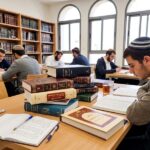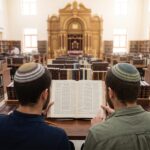

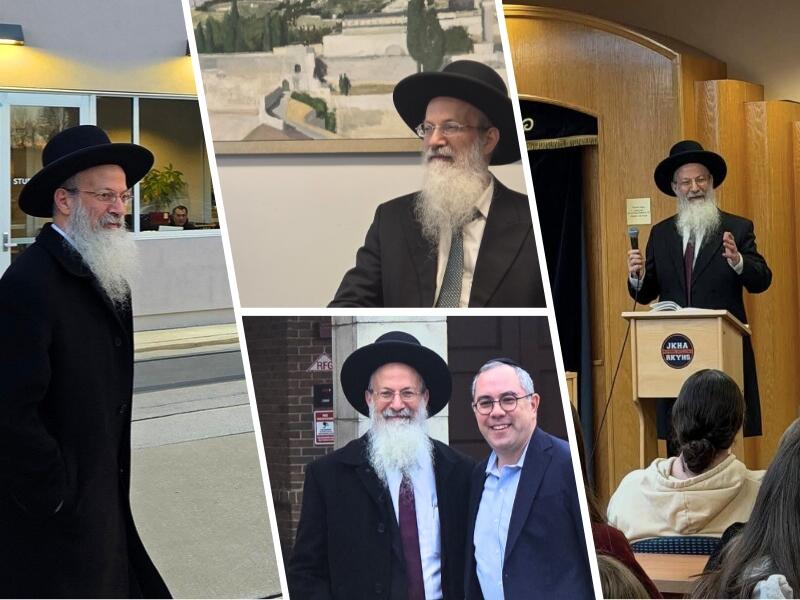
With only the ability to speak Hebrew, I traveled to the United States * The purpose of the trip was to teach Torah, meet our Jewish brethren, learn about their strengths and the challenges they face * The classes and meetings were mainly with communities and schools belonging to what is known as the “Modern Orthodox” public * I met a Zionist community for whom the Land of Israel is very dear * Many people are seriously considering Aliyah * In all communities, Psalms were recited at the end of prayers for the success of IDF soldiers * The synagogue rabbis work to strengthen community cohesion and to maintain each member’s connection to the community and to Judaism * I found myself needing to describe the goodness of the Land, since the media naturally focuses on problems and tensions
A week ago, I returned from a twelve-day tour of the Jewish communities in the New York and New Jersey area. The purpose of the trip was to teach Torah and meet our Jewish brethren, to learn about their strengths, and the challenges they face. In practice, I delivered dozens of classes to rabbis, communities, and students in yeshivot and schools. Usually, at the end of each lesson, I answered questions on halakha and emunah (faith).
At first, I did not think I would go to the United States, but after I traveled abroad for the first time about eight months ago—to serve as a rabbi at a conference of rabbis and emissaries in Paris—people argued that it was important to visit the Jewish communities in America as well. I argued that I did not know English; they replied that indeed this was a serious problem, and yet, there would still be great benefit, since many study the “Peninei Halakha” books, and meeting them would strengthen their connection to Torah, and to the Land of Israel.
Incidentally, when I was a student in the middle school of the Yeshiva High School adjacent to Merkaz HaRav, the righteous Rebbetzin Mendelcorn was our English teacher. But at the time I wanted to study Mishnah. She tried to persuade me to attend English class, but even then, I knew I wanted to devote my life to Torah, and did not want to “waste time” on English. When she argued that millions of Jews speak only English, I replied that instead of my learning English, they should learn Hebrew. From then on, I stopped studying English. About twelve years later, I gave a lecture for women at the Yeshurun synagogue in Jerusalem. After the class, Rebbetzin Mendelcorn approached me, and asked: “Do you remember that you didn’t want to learn English, and what I told you?” I replied: “Of course I remember.” She continued: “And what do you think now?” I answered: “Now I regret that I don’t know English.” She was very happy to hear my honest answer and called her friends so they could hear it too. So, retrospectively, I became one of her beloved students. And thus—with only Hebrew—I traveled to the United States.
Modern Orthodox
The classes and meetings were mainly with communities and schools of the “Modern Orthodox” public, all of whom are Zionist, as well as with Zionist Sephardic communities. Indeed, I met a Zionist community for whom the Land of Israel is very dear, and the past two years—in which we have fought our enemies on all sides—have greatly strengthened their identification with the State of Israel and their desire to make Aliyah, and participate in building the country, and safeguarding its security.
In all communities, Psalms were recited at the end of prayer for the success of IDF soldiers. In our community in Har Bracha, we stopped saying these Psalms more than a month ago, at the start of the cease-fire since, from that time, the tension and concern for the many residents on the front lines decreased greatly. It is fitting to reserve special prayers for a time when the war is in full force, and concern is high. When I told one of the rabbis that we no longer recite these Psalms, he explained that since they are far away, they must be even more careful not to appear indifferent to what is happening in Israel. I replied with a smile that this is similar to the “Second Day of Yom Tov in the Diaspora.”
In the courtyard of the Bnai Yeshurun synagogue in Teaneck, small lanterns had been placed—one for each hostage, including those still not brought to burial. On Motzei Shabbat, after Maariv, they went outside and recited Psalms, and a child removed two lanterns corresponding to the two bodies recovered that Shabbat. Tears came to my eyes from the intensity of their solidarity.
In almost all meetings with rabbis or communities, time was devoted to questions and answers, and some of the questions related to Israel’s security situation and internal social tensions, including how the Haredim could be enlisted into the army. In general, I found myself needing to describe the goodness of the Land, since the media naturally focuses on problems and tensions, and does not work to describe the great brotherhood that prevails in Israeli society, as expressed in joint military service. Nor do they frequently report on the rapid economic and scientific development of the State of Israel.
Incidentally, external appearance as classified in Israel does not match norms abroad. At one meeting two young men, about twenty-five, participated. They looked like members of the Lithuanian-Haredi community in Israel, yet from their question—why the Haredi community evades army service and opposes core curriculum studies—it was clear that they supported the National-Religious path. Indeed, it turned out they study science at prestigious universities, and plan to make Aliyah after finishing their studies.
Growing Desire for Aliyah
Joining us on the trip was Dr. Raphael Kayim, a physician who made Aliyah from New York about thirty years ago, at around age forty-four. Many times, he translated my words into English. In the past he would say, ironically, that if you want to end a conversation with American Jews, start talking about Aliyah—but today, for many, raising the topic does not end the conversation. Many people are seriously considering Aliyah. In the past, Aliyah did not stand at the center of the agenda; now it is at the top. Investment in education is bearing fruit. For years, along with the emissaries who come from Israel, rabbis have been educating for love of the Land and the value of Aliyah, and gradually, more and more Jews want to move to Israel.
Many already have a close relative who has made Aliyah. For example, before boarding the plane back to Israel, a Jew approached me and told me he had attended one of the classes, and that he too was flying to visit Israel to meet his father who made Aliyah a few years ago, and to meet his son and daughter-in-law, who made Aliyah a few months ago. The principal of one of the schools told me that his children have already made Aliyah, and that he too plans to follow soon. This is the situation of many rabbis and educators—so much so that at times, they must be strengthened to continue their sacred mission in the Diaspora. A mission that yields rare, wonderful fruit, for the contribution of American olim to building the Land is tremendous.
For a few days, we stayed in central Manhattan with a family whose son made Aliyah for a year of study in a Hesder yeshiva, and decided to continue into combat service. A few months ago, they attended his swearing-in ceremony at the Western Wall, and his photograph with his comrades in formation stands in their living room. Every day they pray for his safety, and the safety of all soldiers. Incredible! Instead of studying medicine at one of the most prestigious universities in the United States as he had planned, he decided to enlist, and then study medicine in Israel. Incidentally, his sister, who spent a year in Israel, is now a student at Columbia University and serves as president of the Hillel Jewish organization, and on a hostile campus, she worked on behalf of Jewish students, and against antisemitism.
“Peninei Halakha”
One evening we arrived at a class and meeting with about ten families who plan to make Aliyah together this coming summer, along with several families considering joining them. This meeting was joyful and encouraging for me, as they told me that about seven years ago one of the community activists began encouraging study of the “Peninei Halakha” books, and as a result, a process of strengthening observance began. For example, several women began covering their hair, and after studying the “Peninei Halakha” volume “The Nation and the Land,” the decision to make Aliyah crystallized. Likewise, a Jew who lives in Manhattan and has an additional home in Florida told me that a young woman from a Haredi background who had left religion had agreed, as a favor, to live in his Florida home while they were in New York. While living there, she saw the “Peninei Halakha” books and began reading the volume on prayer, and since then, she has begun to pray, and is gradually returning to observance. This man often gives the “Peninei Halakha” series as a Bar/Bat Mitzvah gift.
Community Rabbis
The rabbis of the synagogues have a particularly important role in the United States. They are the backbone of the community, and besides their concern for prayers and Torah classes, they work to strengthen communal cohesion and maintain each member’s connection to the community, and to Judaism. And they succeed. Comparing the situation of Modern Orthodox communities thirty years ago to today, one finds that many more Jews attend synagogue for prayers and classes, far more parents send their children to spend a year studying Torah in Israel, and many of those children are also encouraged to make Aliyah. In the past two years, this strengthening has intensified further. We hope that thanks to olim from the United States, this rabbinic heritage will also become more widespread in the Land of Israel. On another occasion I will try to elaborate on what can be learned from the community rabbis in the U.S.
The Straight Path
Despite the great challenges facing the Modern Orthodox public, it seems that this community represents more than any other the true path of Torah in the United States, since it is connected to all the mitzvot of the Torah, without rejecting any value or commandment. Torah study and the observance of its commandments hold great value, as do the sanctity of the nation and the Land, and work and science also have great worth. Alienation from all of this—even if done for the sake of Heaven to preserve tradition—contains a major deficiency, and does not allow movement toward complete repentance and redemption.
In a meeting with rabbis, this topic arose when they said that at times it is difficult to explain to young people seeking to strengthen observance that the proper path is to do so while continuing to embrace the full spectrum of Torah’s values and commandments, and not by following the Haredi path that rejects some of them. One rabbi wrote that educational material on this topic is lacking. That night, I thought about it at length, and decided that after finishing the book I am currently writing (on sacred objects—Torah scrolls, tzitzit, tefillin, synagogues, mezuzot), I will devote time to clarifying the mitzvah of Torah study and, within that, the value of Torah’s completeness in all its parts, and the values of life and its needs.
Is One Obligated to Make Aliyah?
Several times, after the conversation and Q&A session ended, one of the youths approached and asked whether one is obligated to make Aliyah if one’s parents oppose it. I did not want to answer this question; instead, I preferred to refer them to a rabbi who knows them—provided he is a Zionist. For although the principle is that when parents instruct their child to act against the Torah, the Torah must be obeyed—as explained in the Shulchan Aruch (Yoreh De’ah 240:15), and as I wrote in “Peninei Halakha” (Ha’am Veha’aretz 3:8)—I cannot, in practice, give a ruling based solely on this principle, because I do not know the young person or his parents. For example, he may need their emotional and financial support, and if he goes against their wishes and makes Aliyah, he may not succeed in adjusting, and might eventually have to leave Israel. In that case, my answer would not help him fulfill the mitzvah and would only cause him and his parents’ pain and suffering. However, if he consults with a rabbi who knows him, that rabbi will know how to guide him in a way that, while honoring his parents, he can grow closer and closer to the Land, until he will likely merit to make Aliyah successfully. That is, assuming the rabbi is faithful to Torah and all its commandments—that is, he is a Zionist.
This article appears in the ‘Besheva’ newspaper and was translated from Hebrew.