

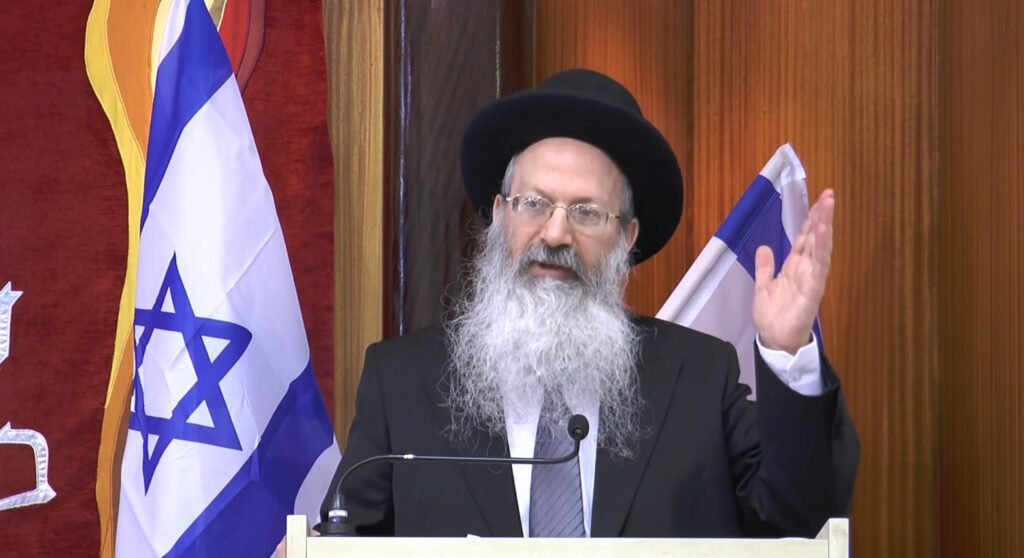
•It is a mitzvah to establish a festive day of joy and thanksgiving to God on the day when salvation was granted to Israel. Thus ruled the Council of the Chief Rabbinate, when it was led by some of the greatest rabbis in the Land.•Rabbi Meshulam Roth wrote that it is a mitzvah to recite Hallel on Independence Day with a blessing, and so instructed my teacher Rabbi Tzvi Yehuda HaKohen Kook, of blessed memory.•On Independence Day, it is an obligation to raise up and honor our heroic soldiers who risk their lives to defend the nation and the land. It is also fitting to remind all celebrants of the establishment of new settlements, and likewise of the rebuilding of destroyed ones, such as Homesh and Sa-Nur.
However, there are great authorities who, due to various concerns, ruled that Hallel should be recited without a blessing, and one who follows them has authorities to rely upon. But one who holds that we should not thank God for the establishment of the State and all the good that has come to Israel through it—has no basis, and by denying God’s goodness distances the redemption.
The Mitzvah of the Festival of Independence Day
It is a mitzvah to establish a day of joy and thanksgiving to God when salvation occurs for Israel. Based on this principle, Purim and Hanukkah were established as festivals for all generations.
Our Sages derived this by a kal va-chomer (a fortiori argument): if after the Exodus from Egypt—when we went from slavery to freedom—we were commanded to celebrate Passover and recite praise each year, then certainly on Purim, when we were saved from death to life.
The Chatam Sofer explained that since this mitzvah is derived through such reasoning, it carries the force of a Torah-level obligation. However, the Torah does not prescribe exactly how to mark such a day; any act commemorating the salvation fulfills the biblical obligation, while our Sages established the specific practices (Megillah reading, festive meal, gifts, etc.).
Establishing Independence Day as a Festival
This is what the Chief Rabbinate determined, led by the great rabbis Rabbi Herzog and Rabbi Uziel. This was also the opinion of most rabbis in the Land, as Rabbi Meshulam Roth explained in his responsa.
Throughout Jewish history, communities established days of joy for miracles far smaller than the establishment of the State of Israel—often calling them “Purim,” such as “Purim Frankfurt” or “Purim Tiberias,” with festive meals and charity.
Reciting Hallel
There is an obligation to thank God for the salvation granted to Israel. Our Sages taught that after the splitting of the Red Sea, prophets instituted that Israel recite Hallel on every occasion of deliverance.
Therefore, it is a mitzvah to recite Hallel on Independence Day, when we were saved from the greatest danger—exile and subjugation, which led to persecutions over two thousand years.
Rabbi Meshulam Roth ruled that Hallel should be recited with a blessing, as did Rabbi Tzvi Yehuda Kook. Others say without a blessing, and one may rely on them. But one who denies the need to thank God at all is rejecting divine goodness.
Spiritual Salvation
The Zionist movement and the establishment of the State of Israel also saved the Jewish people spiritually.
While secularization spread due to modern challenges, settling the Land was not the cause but the solution. Indeed, assimilation and secularization rates are far higher in the Diaspora than in Israel.
Although some participants in the Zionist movement were secular and sought to secularize the people, the positive aspect—the dedication to saving the Jewish people and building the Land—prevailed. Thus, the Jewish people were saved both materially and spiritually.
Torah Study on Independence Day
Independence Day possesses three dimensions of holiness:
The mitzvah of settling the Land
The fulfillment of prophetic visions and sanctification of God’s name
The salvation of Israel from its enemies
Therefore, it is a mitzvah to establish Torah study on this day, as on other festivals.
Our Sages taught that Shabbat and festivals were given for engagement in Torah, and each day has its own themes that should be studied.
Military Service
On Independence Day, we must highlight our heroic soldiers who risk their lives to defend the nation and the land, thereby fulfilling two great mitzvot: saving Israel and settling the Land—each considered of the highest importance.
Mothers and Women
No less than the soldiers, one must honor the mothers and wives who bear the burden at home.
Often, their challenge is even greater, maintaining family life while living with constant concern for loved ones at the front. Their strength, faith, and dedication are a crucial part of the nation’s endurance.
Settling the Land in Judea and Samaria
New communities are being established and existing ones are growing. This too is a great mitzvah to emphasize on Independence Day—encouraging settlement and building families.
Blessing “Matziv Gevul Almanah”
When seeing rebuilt or newly established settlements (such as Homesh and Sa-Nur), one should recite the blessing “Matziv gevul almana” (“Who sets the boundary of the widow,”) if one has not seen the place for thirty days and feels joy upon seeing it.
“Be Fruitful and Multiply”
A central mitzvah—especially emphasized on Independence Day—is building families, which brings blessing to the nation.
Those same righteous women who support their families often also fulfill this mitzvah with great devotion, raising strong families whose children go on to serve and build the nation.
Settling the Land Through Family Growth
Through this mitzvah, Israel inherits the Land, as promised to Jacob: that his descendants would spread in all directions and bless the world.
Ingathering of Exiles
Another great mitzvah is immigration to Israel and absorption of newcomers.
Our Sages said: “The ingathering of exiles is as great as the day heaven and earth were created,” emphasizing its immense spiritual significance.”
This article appears in the “Besheva” newspaper and was transferred from Hebrew.