

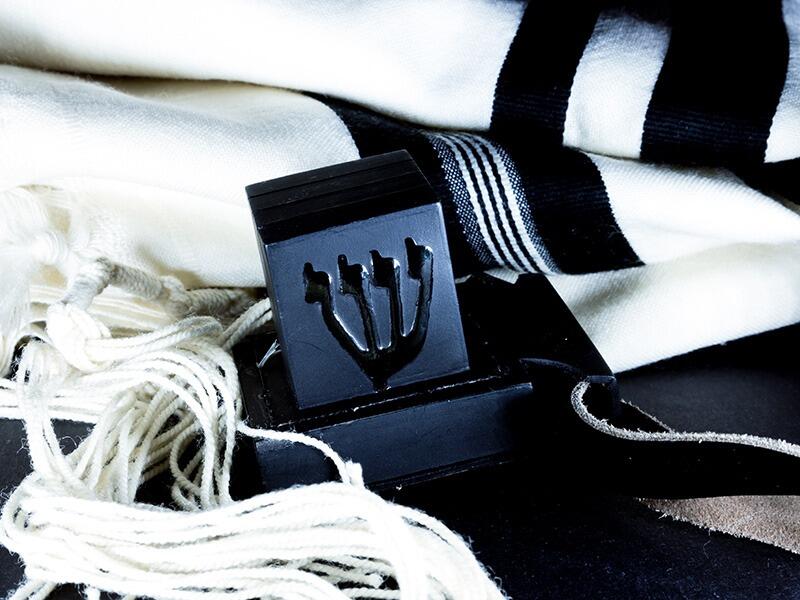
One must purchase tefillin and mezuzot from a God-fearing scribe who is expert in the laws of STa”M (Torah scrolls, tefillin, and mezuzot) * It is an obligation to write the tefillin and mezuzot in the exact order in which they appear in the Torah, and it is impossible to complete or correct a letter that was omitted * There is a mitzvah to beautify mitzvot (hiddur mitzvah), meaning, to add up to one-third to the cost of the mitzvah * Included in hiddur is that the tefillin and straps be attractive, and even that the bag in which the tefillin are kept be nice * The common practice is not to check tefillin unless something unusual occurred that might invalidate them
From Whom Should One Purchase Tefillin and Mezuzot
One must purchase tefillin and mezuzot from a God-fearing scribe who is expert in the laws of STa”M (acronym for the Hebrew words: Sifrei Torah, Tefillin, Mezuzot, and refers to the special script used in writing them), whose testimony regarding the kashrut of the items can be relied upon. One who buys them from an unknown person, risks acquiring invalid tefillin or mezuzot—something that even the most meticulous inspection may not reveal.
Fear of Heaven is tested, first and foremost, through honesty and integrity between people, and through the willingness to forgo money, rather than stumble, or cause others to stumble, in theft or falsehood.
Beyond this, hiddur mitzvah (beautifying the mitzvah) is to purchase tefillin from a righteous scribe who is meticulous in mitzvot between man and God, and between man and his fellow, who sets fixed times for Torah study, prays with a minyan, pays taxes according to the law, and fulfills the mitzvah of Yishuv Ha’Aretz (settling the Land of Israel). If he also served as a soldier who risked his life defending the Nation and the Land, his stature is especially great.
Since beard length, or external appearance, do not testify to a seller’s reliability, one who does not personally know a trustworthy scribe or merchant, should consult a rabbi he knows and trusts, regarding where to purchase tefillin and mezuzot.
Examples Demonstrating the Need for High Reliability
If a scribe forgot to have intent (kavanah) before writing the tefillin or mezuzah that he is writing them for the sake of the mitzvah, or forgot to have intent when writing the Divine Names that they be written for the sanctity of God’s Name, the parchments are pasul (invalid). Since this cannot be detected through inspection, only a God-fearing scribe will set aside such parchments, and place them in a geniza (repository). One who lacks fear of Heaven and integrity in monetary matters, may sell them as if they were kosher.
Likewise, if the scribe omitted a letter or wrote it incorrectly, there is no way to fix the error in tefillin or mezuzot due to the rule of ‘shelo kesidran’ (“not in order”), as it states: “And these words shall be” (Deuteronomy 6:6) — “they must remain as they are.” Thus, the tefillin and mezuzot must be written in the order they are written in the Torah, and an omitted letter cannot be fixed or added later (Shulchan Aruch, Orach Chaim 32:23).
If the scribe is dishonest, he may illegally correct the error so as not to lose many hours of work, and magi’im (inspectors who check for errors) will have no way of knowing that an invalidating correction was made.
Similarly, if the scribe is not knowledgeable in halakha, he may invalidate a Torah scroll, tefillin, or mezuzah through chak tochot (forming letters by erasure) without realizing it. For example, if one mistakenly wrote a vav instead of a yud, it is forbidden to scrape part of the vav to make it a yud; rather, the entire vav must be erased and rewritten (Shulchan Aruch, Orach Chaim 32:17–18).
Hiddur Mitzvah and How Much One Should Pay
There is a mitzvah to beautify mitzvot, as it states: “This is my God and I will glorify Him” (Exodus 15:2) — “Beautify yourself before Him with mitzvot” (Shabbat 133b). We also find that God accepted Abel’s offering, which was from the firstborn and the choicest, but did not accept Cain’s offering, which was meager and ordinary (Genesis 4:3–5).
Our Sages taught that one should add up to one-third to the cost of a mitzvah for hiddur (Bava Kamma 9a). For example, if kosher tefillin made from behaima gasa (tefillin made from the thick, durable hide of adult cattle) cost about 2,000 shekels, the mitzvah of hiddur would be to spend up to 2,666 shekels. Some authorities hold that the third is calculated from the final price, in which case the hiddur amount would be 3,000 shekels.
If one wishes to add more than a third in order to beautify the mitzvah further, God will reward him—provided that this does not come at the expense of more important mitzvot, and all the more so, at the expense of repayment of debts, or basic household needs.
Hiddur for the Poor and the Wealthy
The obligation of hiddur up to one-third applies to an average person. One who is financially strained is not obligated to add a third. Conversely, one who has been blessed with wealth should beautify mitzvot beyond a third—especially if he regularly spends far more than average on clothing and furniture.
What Constitutes Hiddur
Hiddur includes that the tefillin and straps be nice-looking, that the tefillin bag be nice and replaced when worn, and that one fulfill even stricter opinions that were not established as halakha.
Some manufacturers advertise long lists of stringencies and beautifications, but these are often unimpressive, since most apply to standard tefillin, or relate to remote concerns. At times, a feature considered a hiddur according to one opinion, may be problematic according to another. Therefore, one who is not expert should rely on a trustworthy, God-fearing scribe or merchant to guide him.
Checking Tefillin
Tefillin that were properly checked at the time they were made do not need to be checked again, as long as they were not damaged, and are worn regularly. If worn only occasionally, they should be checked twice every seven years (Shulchan Aruch, Orach Chaim 39:10). Unnecessary checking can even be considered disrespectful to the tefillin. However, in the opinion of many later authorities, it is proper le-chatchila (ideally) to check the tefillin twice every seven years, as our Sages said regarding mezuzot, because it is possible that they were damaged due to sweat (Mishnah Berurah 39:26). And there are those who wrote that it is an act of piety to check the tefillin every year in the month of Elul (Mateh Ephraim 581:10; Kitzur Shulchan Aruch 128:3). However, their words were said regarding tefillin made from behaima daka (thin animal hide), whereas today, when almost everyone wears tefillin made from thick animal hide, the tefillin are far more protected, and the concern that they may have become invalid has been removed. In practice, the custom is not to check tefillin as long as no special incident occurred that could invalidate them. Thus ruled Rabbi Auerbach (Halichot Shlomo, Prayer 4:36). The same applies to a mezuzah that was sealed in nylon, for there is no concern that it will become invalid, and it does not need to be checked twice every seven years.
One Who Leaves Tefillin in a Car in High Heat
One who regularly leaves his tefillin in a car, and at times they are in very high heat, it is proper to check them twice every seven years. However, this is not an obligation, for according to the testimony of tefillin inspectors, even after tefillin made from thick animal hide were exposed to such heat, it is very rare to find any invalidation. If, due to the heat or because they became wet the stitching opened, they must be checked immediately.
One Whose Tefillin were Discovered to be Invalid After Many Years
If a person purchased parchments that were written by a God-fearing scribe and were properly checked, and after years he opened them and discovered that there was a disqualification in them, according to many authorities, since he did what was incumbent upon him in checking the tefillin that he purchased, he is considered as one who fulfilled his mitzvah. This is similar to what our Sages said (Kiddushin 66b) regarding a kohen (priest) who served in the Temple and was later found to be the son of a divorced woman, and therefore disqualified from the priesthood: although from that point onward every offering he would bring is invalid, nevertheless, the offerings he brought until then for Jews are valid, and they do not need to be offered again (Da’at Kedoshim 39:9; Pri HaSadeh 3:117; Sha’arim Metzuyanim BaHalakha 10:3; Tzitz Eliezer 22:1, and similarly in Rav Pe’alim, Orach Chaim 4:2; and not like Yabia Omer, vol. 7, Orach Chaim 5).
Distressing Problems in Inspections
It is appropriate to note with sorrow, that at times, when tefillin are given for inspection, even though the tefillin are in good condition, the inspector searches for defects, and finds them. This is done in order to cause the owner of the tefillin to purchase new parchments from him, and to pay him for refurbishing the tefillin. Although he is careful with his wording, and emphasizes that it is not clear whether the defects he found invalidate them, he explains that in order to remove doubt, it is preferable to replace the parchments, and renew the boxes. At times this involves an inspector from a particular group who views other groups unfavorably, and therefore, his heart inclines him to find problems in the parchments and tefillin of scribes and manufacturers from other groups. However, had the owner of the tefillin turned to an inspector from the same group as the scribe or manufacturer, he would have found that the tefillin are kosher and proper.
The reason that defects can be found even in kosher parchments is that the writing is done by hand, and it is therefore natural that the letters are not uniform, and that there are differences between scribes. Consequently, when one wishes, it is often possible to find some letter that was written slightly differently and to cast some degree of doubt upon it. In addition, over the years, the tendency to beautify and to be stringent has increased, and as printing spread throughout the world, the form of the letters became fixed according to higher standards; that which was once considered beautified is now considered merely kosher, and that which was once considered kosher, is now considered kosher only be-di’avad (post facto). Even parchments that were written about forty years ago by God-fearing scribes, and were then considered beautified—there are proofreaders today who will cast doubt on their validity. Within this framework, it is easy for an inspector who does not seek the good of the parchments to find defects in them, even though they were written by the finest scribes. However, our Sages warned not to cast aspersions on earlier generations, and those who cast doubt on the forms of the letters of God-fearing scribes from previous generations, are sinners.
Therefore, when there is a need to check tefillin, they should be checked by a God-fearing proofreader, preferably one who belongs to the same group as the scribe, and not by people who volunteer to proofread tefillin for free.
This article appears in the ‘Besheva’ newspaper and was translated from Hebrew.